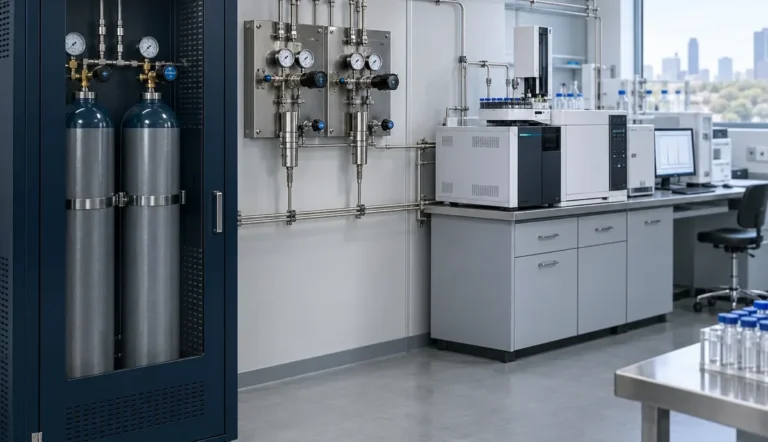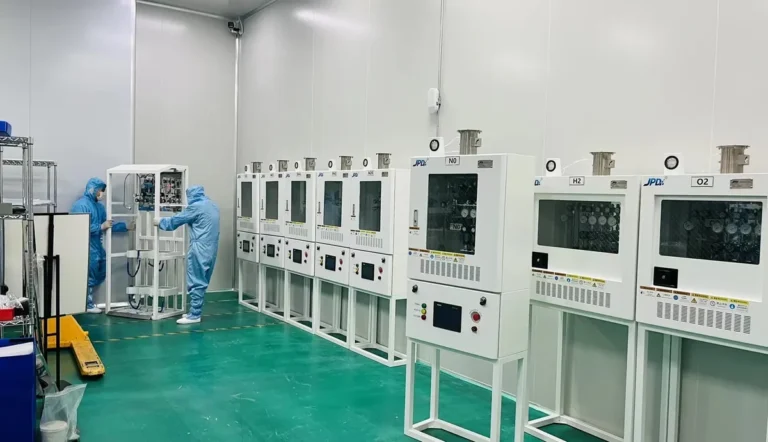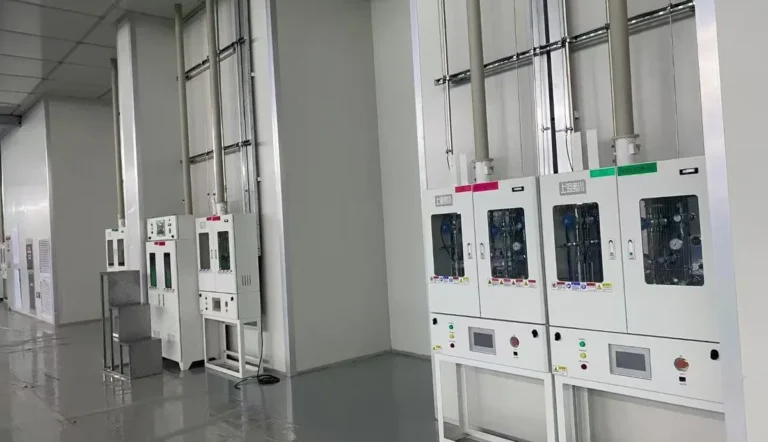

Quick answer: A cleanroom gas cabinet is installed correctly when four requirements are met at the same time: the cabinet is placed in the right zone (usually a service chase, gas room or sub-fab rather than the clean process area), it is anchored and connected without contaminating the cleanroom, its exhaust and safety interlocks work with the room’s pressure and monitoring systems, and the complete gas path passes leak, purity and functional tests before process gas is introduced. A practical installation sequence is: site readiness review, clean delivery and positioning, anchoring, exhaust tie-in, utility and electrical connections, process line hook-up under clean conditions, leak testing, purge and purity certification, interlock testing, and documented handover.
How this guide differs from general gas installation advice: general guidance on routing and joining laboratory gas lines is covered in the laboratory specialty gas installation guidelines, and cabinet types and features are explained in the specialty gas cabinets selection guide. This article focuses on what changes when the gas cabinet is installed in or next to a cleanroom: zoning, contamination control during construction, wall and floor penetrations, exhaust and room pressure interaction, cleanroom-grade hook-up and the qualification tests that cleanroom owners expect.
What makes cleanroom gas cabinet installation different from a standard laboratory installation?
Cleanroom gas cabinet installation differs from a standard laboratory installation because the installation itself must not contaminate the cleanroom, and because the cabinet’s exhaust, penetrations and safety systems interact with a controlled environment. In a standard laboratory, drilling dust, packaging debris and open tube ends are a nuisance; in an ISO-classified cleanroom they can delay certification, contaminate tools and add particles to process gas lines. The installation therefore follows clean construction protocols, uses cleanroom-compatible materials and is coordinated with the cleanroom contractor and the facility owner.
The gases are also usually more demanding. Cleanrooms for semiconductor research, compound semiconductors, photovoltaics, MEMS and advanced materials often use toxic, pyrophoric, corrosive or flammable specialty gases at ultra-high purity. The installation must therefore meet both safety requirements, such as exhaust, gas detection and emergency shutoff, and purity requirements, such as low helium leak rates, low moisture and low particle levels at the point of use.
Where should a gas cabinet be located in a cleanroom facility?
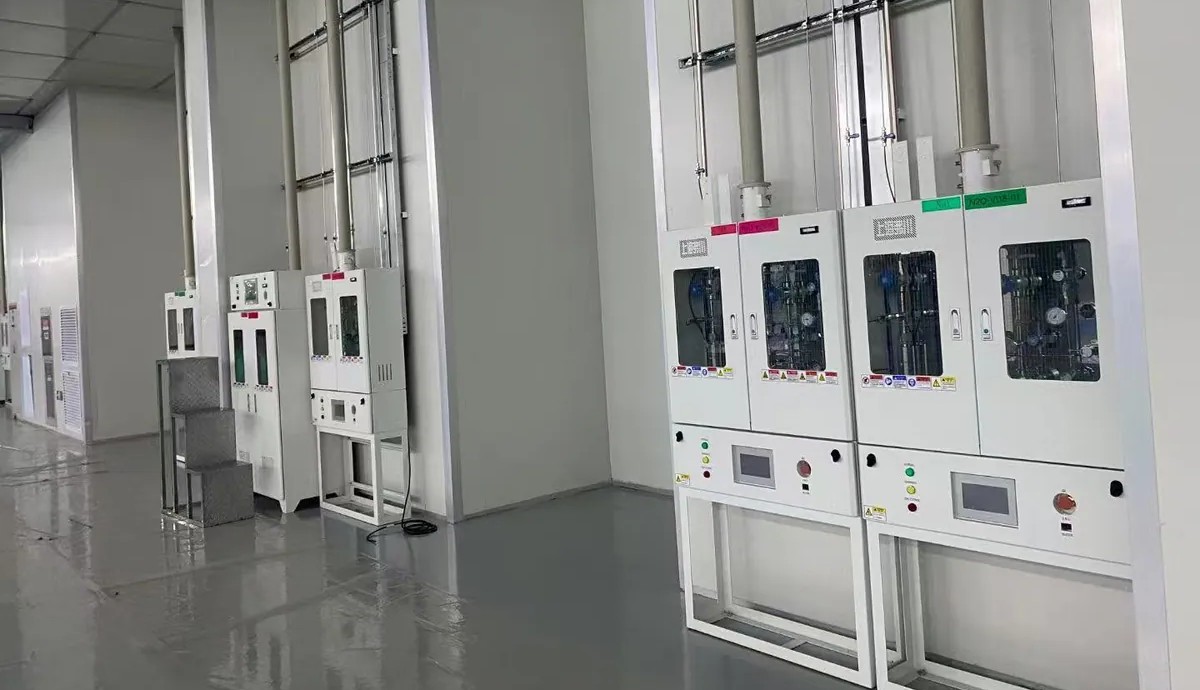
A gas cabinet in a cleanroom facility should normally be located outside the clean process area, in a service chase, grey area, dedicated gas room or sub-fab, with process lines routed through sealed penetrations to the tools. Placing cabinets outside the clean zone keeps cylinder handling, cylinder trolleys and maintenance activity away from the cleanroom, simplifies exhaust routing and allows gas suppliers to change cylinders without gowning. It also limits the consequences of a leak, because the cabinet area can be designed with dedicated exhaust and detection.
Small research cleanrooms sometimes place gas cabinets inside the cleanroom when there is no service chase. In that case the cabinet should be placed near the wall closest to the exhaust riser and cylinder access route, away from doors and air returns that could spread a leak, and the cylinder change procedure must include cleanroom-compatible handling of cylinders. The location decision should be made with the facility’s fire code consultant and the authority having jurisdiction, because hazardous gas rooms often have specific construction and separation requirements.
| Location | Advantages | Limitations |
|---|---|---|
| Service chase / grey area | Close to tools, no gowning for cylinder changes, short gas lines | Limited space; needs exhaust and detection in the chase |
| Dedicated gas room | Best separation of hazards, centralized monitoring | Longer lines; requires a fire-rated room in many codes |
| Sub-fab | Ample space, direct exhaust and utilities | Vertical runs to tools; requires coordinated floor penetrations |
| Inside the cleanroom | Shortest lines for small labs without chases | Cylinder handling in the clean area; higher contamination risk |
What site readiness checks are needed before a cleanroom gas cabinet arrives?
Before a cleanroom gas cabinet arrives, the installation team should confirm that the cleanroom construction stage, the cabinet location, the utilities and the access route are ready. The floor or plinth must be finished and level, wall panels and ceiling must be complete in the area, and any concrete drilling, cutting or welding of building structures should be finished so that dusty work does not follow the cabinet. The exhaust duct, power supply, clean dry air, purge nitrogen, vent line, gas detection cabling and network connections should be at the cabinet location or clearly planned.
The access route needs special attention in cleanroom buildings. Doors, airlocks, pass-throughs and corridors must be wide and tall enough for the crated cabinet and the handling equipment, and floor loading must be checked for heavy units. A readiness checklist signed by the cleanroom contractor and the gas system installer avoids the common situation where a cabinet waits weeks in a warehouse or, worse, is installed before the room is clean.
How should a gas cabinet be delivered into a cleanroom area?
A gas cabinet should be delivered into a cleanroom area by removing outer packaging and transport crates outside the clean zone, wiping down the cabinet surfaces with cleanroom-compatible cleaning agents and lint-free wipes, and moving it through the designated material entry or airlock on clean wheels or a dedicated trolley. Wooden pallets, cardboard and foam should never enter the cleanroom, because they shed particles and fibers. The inner protective film should be removed only after the cabinet is in position.
Gas panel components inside the cabinet should remain capped until hook-up. Factory-capped tube ends, bagged components and purged panels protect the internal surfaces of electropolished tubing from moisture and particles. Any cap found missing or damaged on delivery should be recorded, because the affected section may need additional purging or cleaning before it can be qualified.
How should a cleanroom gas cabinet be anchored?
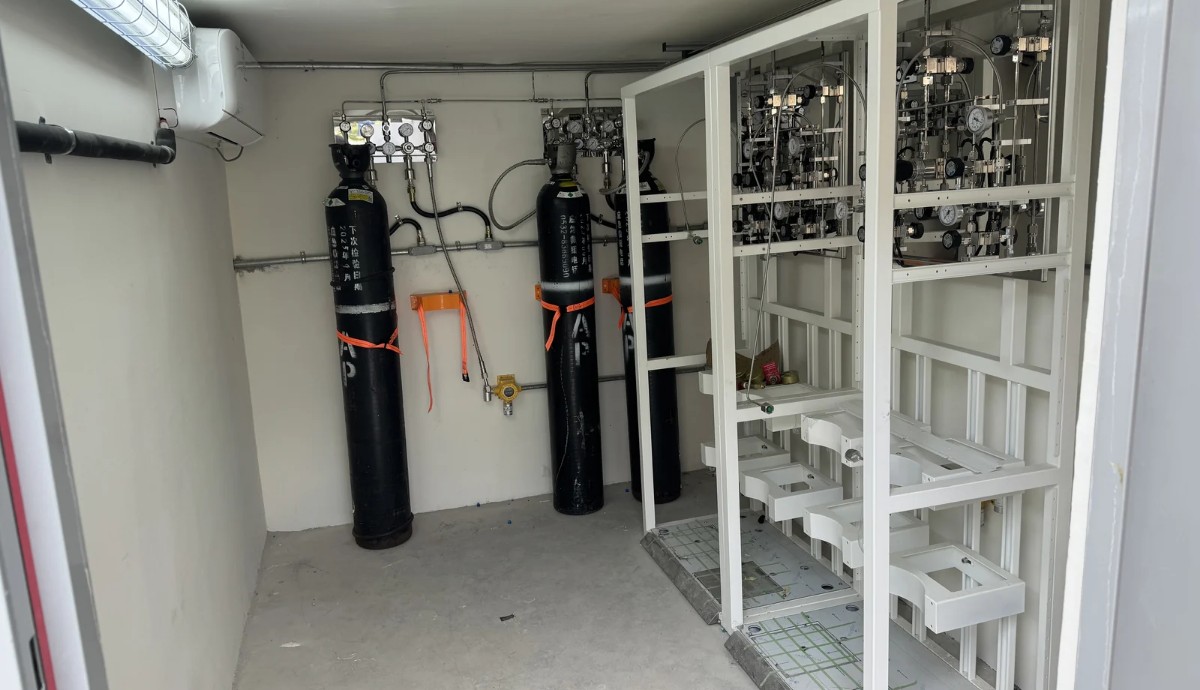
A cleanroom gas cabinet should be anchored to the floor, a support plinth or a wall structure with fixings that resist tipping, vibration and, where required, seismic loads. Cylinder weight is concentrated high in the cabinet, and an unanchored cabinet can tip during cylinder changes or earthquakes. Most cabinets are fixed through base holes or brackets into the structural slab or a steel plinth, and cylinders inside the cabinet are restrained with chains or straps at the heights specified by the manufacturer.
In cleanrooms with raised access floors, the cabinet should be supported by a dedicated pedestal or frame that transfers the load to the structural slab, because standard raised floor tiles are not designed for concentrated cabinet and cylinder loads. Drilling into the slab should be done before the cleanroom is commissioned, or under local extraction with dust control if the room is already operating. Seismic anchoring requirements depend on the site and should be confirmed by a structural engineer.
How should wall, ceiling and floor penetrations be made and sealed?
Wall, ceiling and floor penetrations for cleanroom gas cabinets should be planned on the layout drawing, cut with dust control, and sealed with cleanroom-compatible sealing systems that maintain the room’s pressure and fire rating. Gas lines, exhaust ducts and cables typically pass from the service chase or sub-fab into the cleanroom through prefabricated penetration plates or sleeves in the wall panels or floor. Each penetration should be sealed with non-shedding, low-outgassing sealant or gaskets so that unfiltered air from the chase cannot leak into the cleanroom.
Where penetrations pass through fire-rated walls or floors, listed firestop systems must be used, and the firestop must be compatible with the cleanroom finish. Labeling each gas line at both sides of the penetration with gas name, flow direction and source simplifies later maintenance and emergency response. Uncontrolled field-cut holes in cleanroom panels are a common cause of pressure loss and certification problems.
How should the cabinet exhaust be connected in a cleanroom building?
The cabinet exhaust should be connected to a dedicated hazardous exhaust system, not to the general cleanroom return air or to the general building exhaust, and the duct material must be compatible with the gas being handled. Corrosive gases usually require corrosion-resistant ducts, flammable gases may require separate exhaust branches, and toxic gases may require abatement or a scrubber before discharge. The exhaust connection should include an accessible damper for balancing and an exhaust flow or pressure sensor that the cabinet controller monitors.
Exhaust balancing must consider the cleanroom pressure cascade. Each gas cabinet removes air from the room or chase where it stands, so the make-up air system must supply enough air to keep the cleanroom at its design positive pressure relative to the chase and the chase at its design pressure relative to outside. Gas cabinet exhaust should be confirmed by measuring access window face velocity or cabinet negative pressure after balancing, and the result recorded. Treatment of the exhaust stream is covered in laboratory gas exhaust treatment and purge systems.
Which utilities and electrical connections does a cleanroom gas cabinet need?
A cleanroom gas cabinet typically needs control power, purge nitrogen, clean dry air for pneumatic valves, a vent connection for purge and relief gases, and in some cases a vacuum source for vacuum-assisted purging. Control power is often supplied from an uninterruptible or emergency power source so that monitoring and shutdown remain active during power loss. Purge nitrogen should be of a purity equal to or higher than the process gas requirement and delivered through a dedicated line with backflow protection.
Electrical work must follow the hazardous area classification of the location. Cabinets for flammable gases may require explosion-protected components or purged enclosures, depending on the code and the cabinet design. All metal parts, including the cabinet frame and gas lines, should be bonded and grounded, and cable entries should be sealed to maintain the cabinet’s exhaust containment.
How should process gas lines be hooked up under cleanroom conditions?
Process gas lines should be hooked up under cleanroom conditions by using pre-cleaned electropolished stainless steel tubing and components, orbital welding or face-seal fittings, continuous inert gas purge during welding, and gloved handling that never touches wetted surfaces. Tube ends should remain capped until the moment of connection, and cutting should be done with tube cutters designed for high-purity tubing followed by facing and cleaning, not with saws that create chips. Welding areas inside the cleanroom should be screened and extracted.
Toxic and pyrophoric gas lines often require coaxial double-containment tubing between the cabinet and the valve manifold box or tool, with the annular space monitored for leaks. Every weld should be identified on a weld map with its welder, weld schedule and inspection result, and sample coupons should be made at the start of each shift to verify weld quality. Guidance on selecting tubing and fittings is available in the laboratory gas piping and fittings procurement guide, and distribution hardware such as the JW-200-VMB / JW-100-VMB valve manifold box connects cabinets to multiple tools.
Which leak tests are required after cleanroom gas cabinet installation?
After cleanroom gas cabinet installation, the gas path should pass a pressure test, a pressure decay test and a helium leak test before any process gas is introduced. The pressure test proves mechanical strength at a test pressure above the maximum operating pressure, as defined by the applicable code and design. The pressure decay test holds the system at pressure for a defined period and confirms that the pressure does not fall beyond the allowed limit after temperature correction.
The helium leak test is the most sensitive and is usually performed in two ways: inboard testing, where the system is evacuated and helium is sprayed on each joint, and outboard testing, where the system is pressurized with helium and each joint is sniffed. Ultra-high-purity systems commonly specify leak rates in the range of 1 × 10⁻⁹ atm·cc/s helium or better for each joint. Every joint, including factory-made cabinet connections, should be tested and recorded, because damage during transport and installation can open joints that passed at the factory.
How are purge and purity verified before process gas is introduced?
Purge and purity are verified by cycle-purging the installed system with high-purity inert gas, then measuring moisture, oxygen and particles at the outlet until the results meet the specification. Cycle purging, which alternates pressurization and venting or evacuation, removes atmospheric air and moisture far more effectively than continuous flow purging. The number of cycles depends on the line volume and the purity requirement.
Typical purity certification for cleanroom specialty gas systems includes moisture and oxygen measurements at parts-per-billion levels and particle counts at defined particle sizes, measured with calibrated instruments at the end of the line or at the tool connection. The acceptance criteria should be agreed with the cleanroom owner before testing starts. Only after the purity certificate is signed should the process gas cylinder be connected and the cabinet’s own purge sequence be run.
Which safety interlocks must be tested during commissioning?
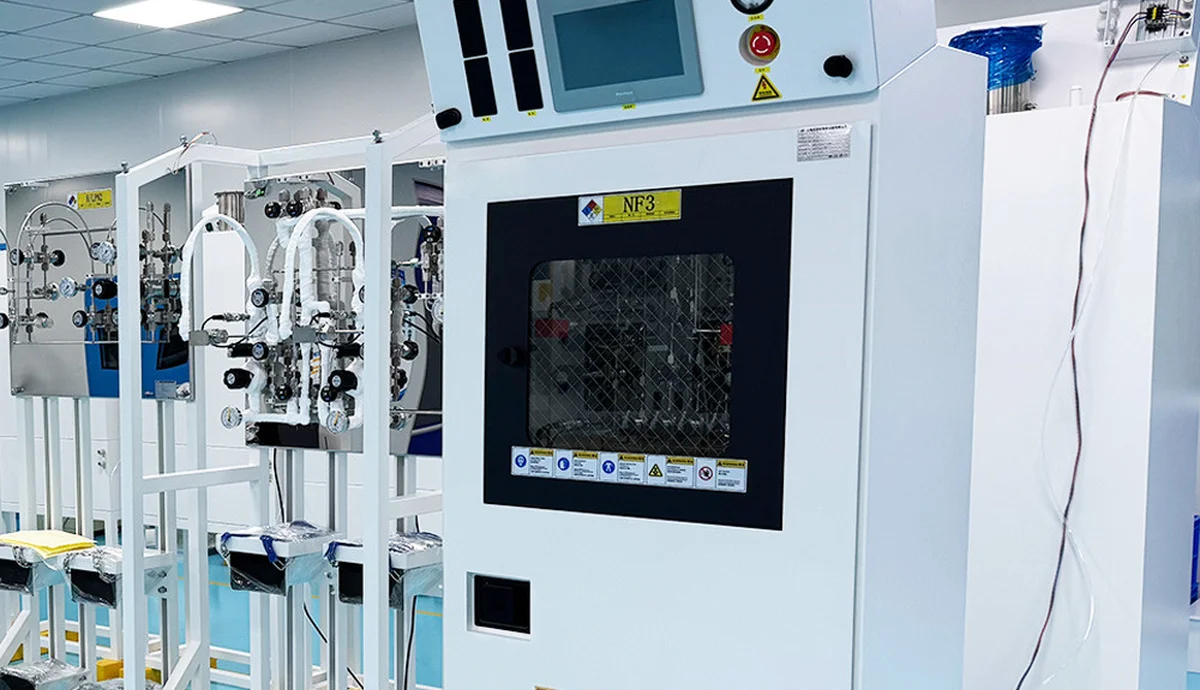
During commissioning, every safety function that can close the gas supply must be tested and recorded. The standard list includes loss of exhaust, gas leak detection at the cabinet and in the area, excess flow, high and low pressure, door or window open, fire or flame detection where fitted, emergency stop at the cabinet and remote emergency stop, power loss and controller fault. Each test should confirm that the automatic shutoff valve closes, the correct alarm is generated locally and at the facility monitoring system, and the system cannot restart until the cause is cleared and reset.
Cleanroom facilities usually connect gas cabinets to a central facility monitoring and control system and to the building life safety system. The integration test should confirm that alarms reach the right control room, that toxic gas alarms trigger the correct evacuation or isolation response, and that the cabinet responds to remote shutdown commands. The cabinet controller of a fully automated unit, such as the JW-300-GC fully automated specialty gas cabinet, records these events for later review.
When should gas cabinets be installed during a cleanroom construction project?
Gas cabinets should be installed after the cleanroom shell, walls, ceiling, floor finish and main utilities are complete, and usually after the cleanroom has reached a basic level of cleanliness, but before the process tools are hooked up. Installing too early exposes cabinets and open gas lines to construction dust; installing too late delays tool start-up. Many projects provide utility taps, exhaust stubs and penetration plates during the base build, then install cabinets during the tool installation phase when the gas list and tool requirements are final.
Freezing the gas list before ordering cabinets is important, because changes in gas type, pressure or flow after delivery can require different regulators, valves or materials. A short coordination meeting between the cleanroom contractor, the gas system supplier, the tool vendor and the facility owner at each project stage prevents most sequencing conflicts.
Who should install a cleanroom gas cabinet?
A cleanroom gas cabinet should be installed by a team experienced in both high-purity gas systems and cleanroom construction, typically the cabinet manufacturer or a specialist gas contractor working under the manufacturer’s procedures. The team should include qualified orbital welders, technicians trained in helium leak testing and purity measurement, and electricians qualified for the applicable hazardous area classification. Installation by general mechanical contractors without high-purity experience is a frequent cause of failed leak tests and contaminated lines.
Buyers should ask the installer for welding procedure qualifications, welder certificates, calibration certificates for leak detectors and purity analyzers, sample test reports and references from similar cleanroom projects. Having the cabinet manufacturer supervise start-up also clarifies warranty responsibility, because the manufacturer can confirm that the cabinet was installed as designed.
What documents should be handed over after cleanroom gas cabinet installation?
After cleanroom gas cabinet installation, the handover package should include as-built drawings and piping diagrams, the weld map and weld logs, pressure, pressure decay and helium leak test reports, purge and purity certificates, exhaust measurement records, interlock and alarm test records, calibration certificates for gas detectors, the cabinet operation and maintenance manual, the cylinder change and purge procedure, and training records for operators. These documents are required for facility acceptance, for regulatory inspections and for future troubleshooting.
A well-organized handover package also supports maintenance planning. Detector calibration intervals, regulator and filter replacement, and periodic exhaust and interlock checks should be scheduled from the handover date. A service framework for this phase is described in after-sales maintenance and annual inspection.
What are the most common mistakes in cleanroom gas cabinet installation?
The most common mistake in cleanroom gas cabinet installation is starting hook-up before the area is clean, which contaminates open tube ends and forces extra purging or replacement of components. The second most common mistake is connecting the cabinet exhaust without rebalancing the cleanroom air system, which can upset room pressure or leave the cabinet with insufficient exhaust.
Other frequent mistakes include unsealed or fire-unrated penetrations, anchoring cabinets onto raised floor tiles, testing only field welds and skipping factory joints, introducing process gas before purity certification, leaving interlocks untested at the facility monitoring system, and incomplete labeling of lines and cabinets. Each of these issues can be prevented with a written installation plan, a readiness checklist and agreed acceptance criteria. Relevant standards and code references are summarized in the laboratory gas equipment safety standards guide.
What does a cleanroom gas cabinet installation checklist look like?
A condensed cleanroom gas cabinet installation checklist covers each phase from planning to handover:
- Planning: gas list frozen, cabinet location approved, code review complete, layout and penetrations drawn.
- Readiness: room finished and clean, utilities at location, access route and floor loading confirmed.
- Delivery: crates removed outside, cabinet wiped down, components capped, damage recorded.
- Mechanical: cabinet anchored, cylinders restrained, penetrations sealed and fire-stopped.
- Exhaust and utilities: exhaust connected and balanced, power, CDA, nitrogen, vent and vacuum connected, grounding complete.
- Hook-up: clean orbital welding or face-seal connections, weld map complete, coaxial lines monitored.
- Testing: pressure, pressure decay and helium leak tests passed and recorded.
- Purity: cycle purge complete, moisture, oxygen and particle results within specification.
- Safety: all interlocks and alarms tested locally and at the facility monitoring system.
- Handover: documents delivered, operators trained, maintenance schedule started.
Frequently asked questions
Can a gas cabinet be placed inside an ISO Class 5 cleanroom?
A gas cabinet can be placed inside a high-class cleanroom only when there is no practical service chase or gas room, and only with strict cylinder handling and cleaning procedures. Most facilities place gas cabinets in a service chase, gas room or sub-fab and route only the process lines into the clean area.
How long does cleanroom gas cabinet installation take?
Installation and commissioning of a single cleanroom gas cabinet typically takes several days to two weeks, depending on line length, welding, testing and purity certification. Multi-cabinet projects are scheduled in phases and depend heavily on site readiness and utility availability.
Does every cleanroom gas cabinet need a scrubber?
Not every gas cabinet needs a dedicated scrubber, but exhaust from cabinets handling toxic or corrosive gases often must be treated before discharge, depending on local codes and permit conditions. The requirement should be confirmed with the authority having jurisdiction during design.
What helium leak rate is acceptable for a cleanroom gas cabinet?
Ultra-high-purity cleanroom gas systems commonly specify helium leak rates of 1 × 10⁻⁹ atm·cc/s or better for each joint. The exact acceptance value should be stated in the project specification and applied to both factory and field joints.
Who is responsible for changing cylinders after installation?
Cylinder changes are usually performed by trained facility technicians or the gas supplier’s personnel following the written cylinder change and purge procedure. Training should be completed and recorded before the cabinet is released for production use.
Plan your cleanroom gas cabinet installation with LGF
LGF Lab Gas Flow designs, manufactures and installs specialty gas cabinets, valve manifold boxes, high-purity gas piping and exhaust treatment systems for cleanrooms, research laboratories and manufacturing plants. Our cabinets, including the JW-200-GC semi-automatic and JW-300-GC fully automated specialty gas cabinets, are factory tested before shipment, and our engineers support site readiness reviews, gas pipeline installation, leak and purity testing and commissioning. See our semiconductor research specialty gas delivery project and learn more about our factory strength and manufacturing capacity.
Planning a new cleanroom or adding gas cabinets to an existing one? Send your gas list, cleanroom layout, cabinet locations and project schedule through the LGF contact page. Our engineers will review your installation conditions and reply with a cabinet configuration, installation scope and quotation. Cleanroom contractors, EPC firms and equipment integrators are welcome to contact us about project cooperation.