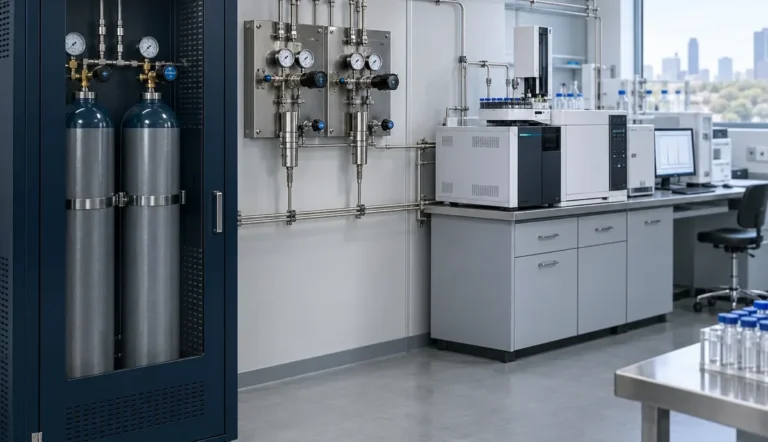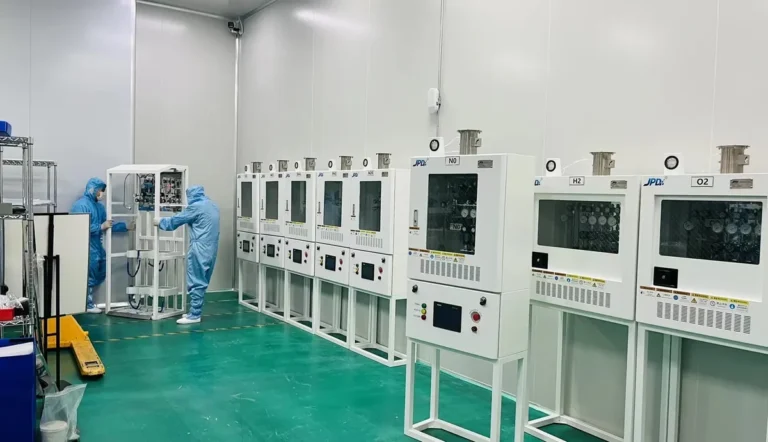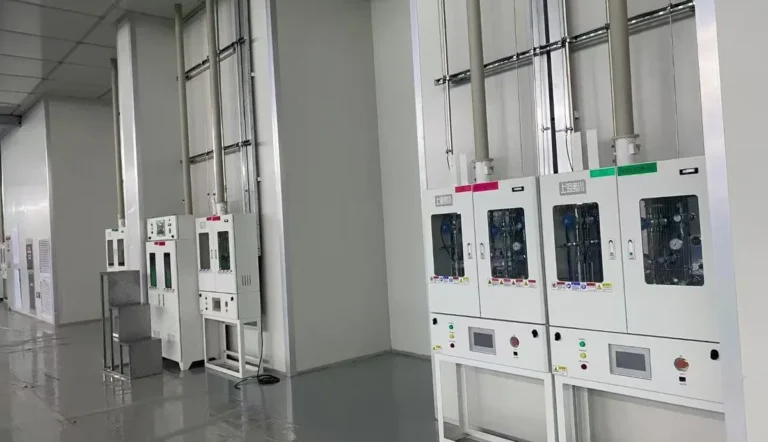

Quick answer: Laboratory gas equipment safety standards are the rules that decide how a regulator, valve, manifold, pipe run, cabinet or scrubber has to be built, labelled, tested and maintained. In practice they fall into four layers:
- Law — occupational safety regulations such as OSHA 29 CFR 1910.101, which incorporate consensus documents like CGA Pamphlet P-1.
- Fire and building codes — NFPA 45 for laboratories and NFPA 55 for compressed gases and cryogenic fluids.
- Association standards — CGA pamphlets for connections, valves, cleaning and pressure relief; SEMI and ISO gas-handling documents for high-purity service.
- Product-grade requirements — material certificates to EN 10204 3.1, helium leak rates, weld qualifications to ASME Section IX, and cleaning to ASTM G93 for oxygen service.
A purchase order that names the standard and the required test evidence is what turns a safety requirement into equipment you can actually commission and audit.
What does “laboratory gas equipment safety standards” cover?
The phrase covers every published rule that constrains how laboratory gas equipment is designed, installed, marked and maintained. It spans three different kinds of document. A regulation is issued by a government body and carries legal force, such as OSHA 29 CFR 1910.101 in the United States. A consensus standard is written by a standards body such as NFPA, CGA, ASTM or ISO, and becomes legally binding either when a regulation incorporates it by reference or when the authority having jurisdiction (AHJ) adopts it locally. An equipment specification is the buying organisation’s own translation of the above into measurable purchase requirements.
That third layer is where most projects fail. A supplier can deliver equipment that fully satisfies every applicable code yet still leave you unable to prove compliance, because nobody asked for the mill certificate, the helium leak report, or the cleaning record. The rest of this guide treats compliance as a documentation chain, not merely a hardware property.
Which organizations write the standards for laboratory gas equipment?
Four bodies account for most of what a laboratory gas project has to satisfy. OSHA writes and enforces the federal occupational safety regulations in the United States. NFPA publishes NFPA 45 (fire protection for laboratories using chemicals) and NFPA 55 (compressed gases and cryogenic fluids code), both of which fire marshals commonly adopt. The Compressed Gas Association (CGA) publishes the pamphlets covering container handling, valve outlet connections, cleaning for oxygen service and pressure relief devices. ISO and ASTM supply the cleanliness, testing and material documentation practices used worldwide.
Outside the United States, equivalent structures apply. In the European Union the Pressure Equipment Directive 2014/68/EU governs assemblies above 0.5 bar, ISO 7396-1 governs medical gas pipeline systems, and high-purity metal systems borrow their cleanliness expectations from semiconductor practice. Because regions adopt different editions, always cite the edition you are designing to and confirm it with the AHJ before issuing the equipment enquiry.
How do OSHA, NFPA and CGA differ in legal force?
OSHA regulations are compulsory where they apply; NFPA codes become compulsory only once adopted; CGA pamphlets are technically industry practice but are pulled into law when OSHA incorporates them. Understanding that hierarchy tells you which document to argue from during an inspection.
OSHA 29 CFR 1910.101(b) requires that in-plant handling, storage and utilisation of compressed gases in cylinders follow CGA Pamphlet P-1. That single sentence converts CGA P-1 from guidance into enforceable federal requirement. The same standard incorporates alternate compliance routes such as the DOT hazardous-materials regulations in 49 CFR Parts 171–179. NFPA 45 and NFPA 55 meanwhile are what a fire marshal actually walks the building with, even though OSHA itself does not always cite them for every occupancy.
| Document | Legal character | What it mainly governs | Typical field evidence |
|---|---|---|---|
| OSHA 29 CFR 1910.101 | Federal regulation | Cylinder handling, storage, use | Cylinder restraints, segregation distance, inspection records |
| OSHA 29 CFR 1910.1450 | Federal regulation | Laboratory chemical hygiene programme | Training records, SOPs, SDS access |
| CGA P-1 | Advisory, binding via 1910.101 | Safe handling of gases in containers | Upright secured cylinders, valve caps, empties separated |
| NFPA 45 | Consensus code, adopted locally | Laboratory fire protection and gas systems | Labelling of long pipe runs, quantity limits |
| NFPA 55 | Consensus code, adopted locally | Compressed gas and cryogenic fluid storage | Oxidiser–fuel gas separation, ventilation, detection |
| CGA V-1 | Advisory, referenced by regulators | Cylinder valve outlet and inlet connections | Gas-specific non-interchangeable connectors |
Reading the table downwards is how an audit proceeds: the inspector finds a physical condition, then looks for the document that requires it and the record that proves it was verified.
How does the gas hazard class change the equipment specification?
Hazard class is the single strongest driver of specification, because it sets the enclosure, detection and venting requirements before any pressure or flow calculation begins. An inert gas at 200 bar needs pressure-rated components and little else; the same pressure of arsine demands a sealed exhausted cabinet, continuous toxic-gas monitoring, automatic shutoff and scrubbing of the purge stream. Specifying by hazard first prevents the very common error of buying excellent hardware that is lawful for nitrogen and unlawful for silane.
| Hazard class | Representative gases | Equipment consequences |
|---|---|---|
| Inert | Nitrogen, argon, helium | Standard industrial materials acceptable; oxygen-deficiency monitoring in small rooms |
| Oxidising | Oxygen, nitrous oxide, compressed air | Cleaning to ASTM G93 or CGA G-4.1; no oil or grease; compatible seals |
| Flammable | Hydrogen, acetylene, methane, propane | Flash arrestors, check valves, excess-flow protection, Ex-rated electrical parts, separation from oxidisers |
| Toxic | Carbon monoxide, ammonia, chlorine, arsine | Enclosed exhausted cabinet, toxic-gas detection, automatic isolation and emergency shutoff |
| Corrosive | Hydrogen chloride, chlorine, ammonia | 316L stainless steel or Monel wetted parts; dry purge provisions |
| Pyrophoric | Silane, diborane, phosphine mixtures | Dedicated enclosure to CGA G-13 principles, diluted release or burn-box, scrubbed vent |
| Cryogenic | Liquid nitrogen, argon, oxygen | Vacuum-jacketed or insulated lines, pressure relief on every trapped section, cold-compatible materials |
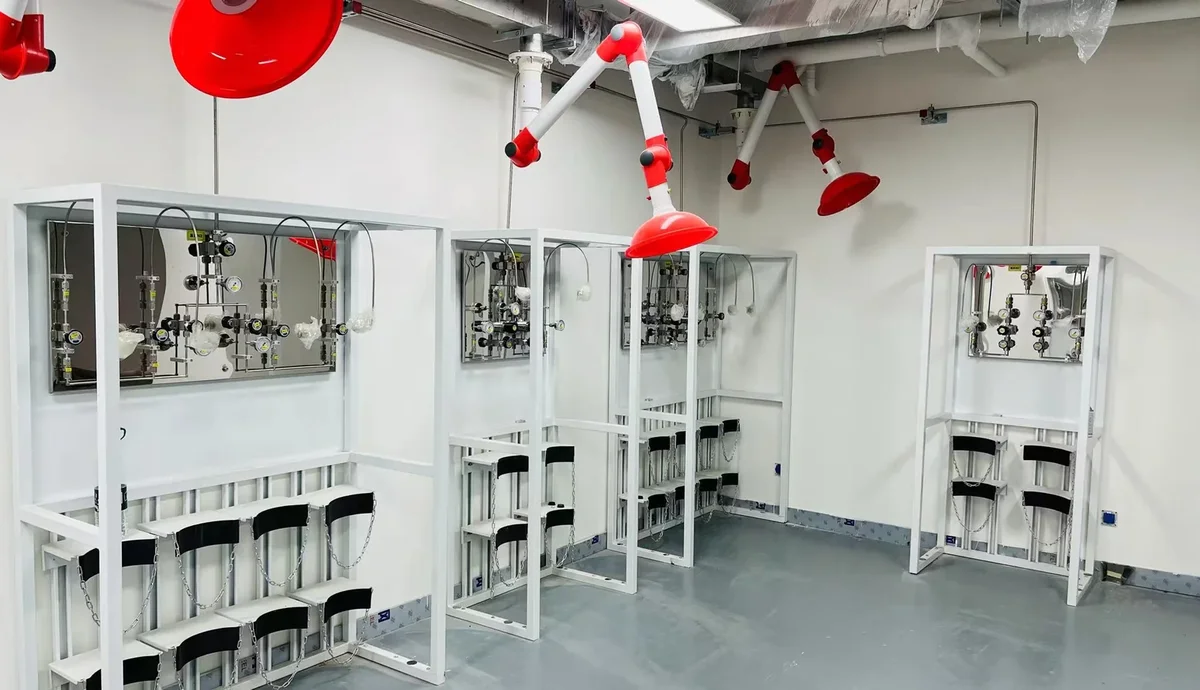
Notice that the equipment consequences are not additive but substitutionary. Moving from inert to flammable does not simply add a detector; it changes the cabinet type, the electrical classification of every device in the room and the acceptable location of the whole installation.
What do the standards require from gas regulators?
A regulator is the boundary between cylinder pressure and manageable line pressure, so standards treat it as a safety device rather than an accessory. NFPA 45 prohibits using a cylinder without a regulator, which means the regulator is part of the compliance boundary, not an optional convenience. The regulator body and diaphragm material must be compatible with the gas, and its inlet connection must match the cylinder valve mandated by CGA V-1 for that specific gas, so that an incorrect gas cannot be physically connected.
Three further requirements follow from that logic. First, pressure rating: regulators must withstand the maximum cylinder pressure, not merely the intended working pressure, because a full cylinder can exceed the nominal figure. Second, relief doctrine: the pressure relief device on a cylinder regulator protects the regulator, not the downstream system, so every downstream vessel, panel or pipe section needs its own relief path vented to a safe location. Third, purity and cleanliness: oxygen and high-purity service call for cleaning to CGA G-4.1 or ASTM G93 respectively, and that cleaning must be documented, because a visual inspection cannot prove absence of hydrocarbon film.
When you buy, specify all four properties explicitly. The nine regulator and valve specifications worth checking before ordering article expands each of these into purchasable line items.
What do the standards require from laboratory gas valves?
Valve requirements are driven by the function the valve performs: isolation, metering, back-flow prevention or emergency release. Check valves and flash arrestors are expected wherever reverse flow could mix gases, most importantly where a fuel gas shares infrastructure with oxygen. Isolation valves must be identifiable, reachable, and protected against accidental operation; NFPA 45’s labelling emphasis on long pipe runs exists precisely because an unlabelled run cannot be safely isolated during an emergency.
Material specification follows the gas rather than the catalogue. Brass is acceptable for dry non-corrosive inert service and is economical, but should not be used for ammonia-reactive environments or for ultra-high purity service. 316L stainless steel with electropolished internal surfaces is the default for corrosive gases and for high-purity lines, while diaphragm-sealed designs are preferred over packed-gland designs because stem leakage is not merely product loss but a release inside the laboratory. Seat materials such as PTFE or PCTFE must be checked against both gas compatibility and the full operating temperature range.
How do cylinder manifolds and changeover systems have to comply?
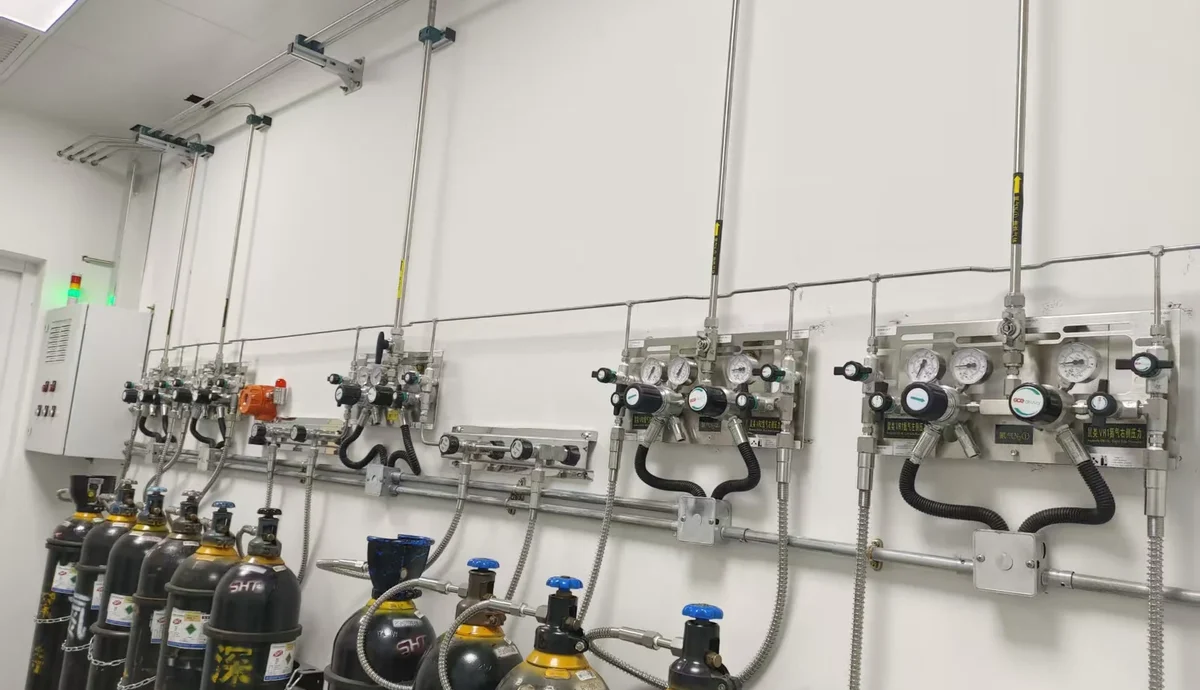
A manifold increases the quantity of gas connected to one line, which increases the size of a credible release. Standards respond by requiring that manifolds be engineered rather than improvised, and by adding specific protective components. Because CGA P-1 expressly forbids assembling manifold systems from assorted laboratory fittings, any installation built from loose components is non-compliant regardless of how well it performs.
The required protection set is well established and easy to specify: a check valve on each cylinder leg to prevent back-feeding into an empty cylinder; pressure relief on any trapped section of header pipe; correctly sized and sloped vent lines discharging to a safe external atmosphere; isolation valves permitting one bank to be serviced while the other supplies the laboratory; and, for toxic or flammable gases, fixed detection in the manifold room with interlocked automatic shutoff. Flammable-gas supply arrangements add the requirement that an emergency shutoff be operable without entering the hazard area.
Automatic changeover between banks is not itself required by most codes, but it is what allows a compliant isolation regime to be used without interrupting continuous instruments; the laboratory gas manifold guide covers the engineering choice in detail.
What governs laboratory gas piping, tubing and fittings?
Piping is governed by design codes rather than by hazard lists. Process-piping practice is normally referenced for material selection, wall thickness, support spacing and pressure testing; ASME Section IX governs welder and procedure qualification for the orbital welds used on high-purity stainless systems. NFPA 45 then adds the practical obligations specific to laboratories: pipes must be identified, routed accessibly, protected from physical damage and labelled where the gas identity is not obvious from the surrounding equipment.
Two failure modes dominate real installations. The first is accessibility: a run enclosed above a hard ceiling with no access panel cannot be leak-tested or inspected, and therefore cannot remain compliant over time. The second is undocumented modification: adding an outlet during a tenant build-out or an instrument upgrade without updating the system diagram breaks the chain of evidence the next inspection depends on. Both are prevented by a written change-authorisation rule rather than by any hardware purchase. The laboratory gas piping and fittings selection criteria and the associated pipeline design process are largely aimed at eliminating these two problems before installation.
When do the standards require an exhausted gas cabinet?
An exhausted cabinet is required when the consequence analysis changes: specifically when a release from the cylinder cannot be safely diluted in the room. That threshold is crossed for toxic, corrosive, pyrophoric and flammable specialty gases, and it is why inert nitrogen may remain on an open restrained rack while silane of identical pressure cannot.
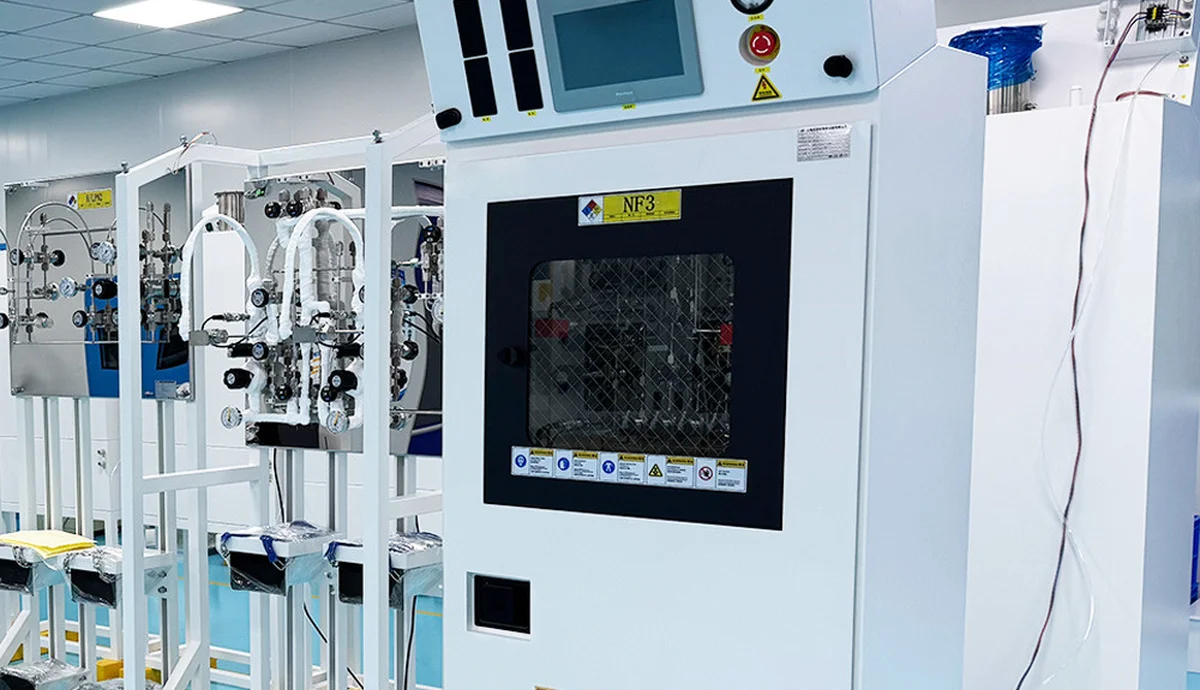
The compliance characteristics that inspectors look for are stable across hazard classes. The cabinet must maintain directed negative-pressure ventilation, contain the connection hardware so that cylinder changes occur at a contained boundary, provide access to emergency shutdown without requiring entry into the hazard, and route its exhaust — through a scrubber where chemistry demands it — to an approved discharge point. Automatic versions add continuous monitoring and interlocked valves driven by the detection signal. Compare cabinet types and their control options in the specialty gas cabinet types and features guide.
What does compliance require at the point of use?
Point-of-use hardware is where laboratory personnel actually interact with gas, so the standards emphasise identification and isolation. Each outlet must be labelled with the gas it delivers, must be controllable locally, and must carry a regulator appropriate to the instrument’s inlet specification. Bench-mounted turrets suit general utility gases such as air and nitrogen for burners, whereas analytical instruments requiring stable pressure and high purity are better served by a dedicated regulator panel whose materials match the required purity tier.
The most common compliance gap at this layer is misidentification. Colour coding is not an acceptable identification method — CGA guidance does not treat cylinder cap colour as reliable — so labelling must be explicit on both the cylinder and the pipe or outlet supplied from it. When the source room and the bench are separated by long runs, that labelling obligation extends along the entire path.
How do the standards treat vent gas and exhaust treatment?
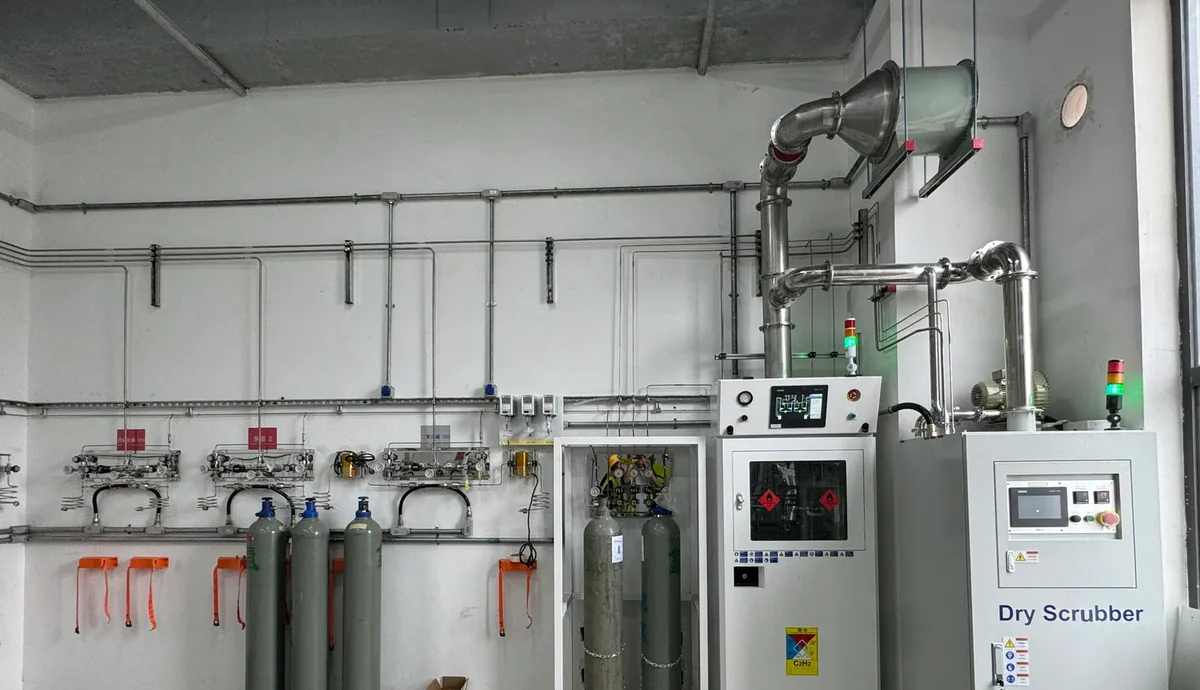
Venting is treated as an environmental and safety end-point, not a detail. Any relief device, purge panel or cabinet exhaust must discharge somewhere that neither exposes people nor breaches local emission limits. That single requirement produces two different answers depending on chemistry: inert and non-hazardous vents may be piped to atmosphere above roof level, whereas toxic, corrosive or pyrophoric streams normally require a scrubber sized for the gas and the flow.
The practical consequence for buyers is that scrubber selection cannot be deferred to commissioning. When the recirculating volume and the peak purge flow are not defined in the equipment enquiry, the installed scrubber is routinely undersized and the system cannot demonstrate compliance even though every component is certified. See the laboratory gas exhaust treatment and purge solutions page for how treatment is matched to gas chemistry.
Prescriptive or performance-based: how do US and EU approaches compare?
United States codes tend to be prescriptive: they state numeric separation distances, storage quantities and measurement frequencies. European directives tend to be performance-based: they require a demonstrated outcome — a documented risk assessment, a conformity declaration and CE marking — while leaving the method to the manufacturer. Both approaches reach similar equipment, but they demand different paperwork.
| Aspect | US-style prescriptive approach | EU-style performance-based approach |
|---|---|---|
| Basis of compliance | Meet the stated numeric requirement | Demonstrate the required safety outcome |
| Key artefact | Inspection record with measured values | Declaration of conformity plus technical file |
| Equipment marking | NRTL listing where electrical | CE marking under PED 2014/68/EU above 0.5 bar |
| Change control | Re-inspect against the same clause | Re-assess conformity for the modified assembly |
| Common failure | Meets the number but cannot show the record | Has the file but lacks the operating evidence |
Whichever regime applies, one requirement is universal: the equipment must be rated and documented for the actual gas, pressure, temperature and flow it will see. Certificates issued for a generic product family do not cover a specific configuration.
What documentation should a compliant equipment package include?
Four categories of document convert hardware into auditable compliance. Material certificates prove what the wetted parts are made of; cleanliness records prove how they were prepared; leak and pressure test reports prove the assembly holds; and declaration documents bind everything to the delivered serial numbers.
| Document | Standard or type | What it proves |
|---|---|---|
| Material certificate | EN 10204 type 3.1 | Actual chemical composition and mechanical properties of wetted components |
| Welding qualification | ASME Section IX, WPQ/PQR | The installer’s orbital welders were qualified to procedure |
| Cleanliness certificate | ASTM G93, CGA G-4.1 | Oxygen or high-purity components were cleaned to the stated standard |
| Helium leak test report | Purchaser-specified leak rate | Assembly integrity below the agreed leakage threshold |
| Pressure test record | Per applicable piping code | The pipework withstands its design pressure |
| Purity or particle test | ISO 14644, oxygen or moisture analysis | The delivered gas meets its specified purity at the outlet |
| Declaration of conformity | Manufacturer declaration | This serialised unit was built and tested as a compliant assembly |
Requesting these documents at quotation stage costs nothing. Requesting them after installation usually either costs a re-test or remains permanently unobtainable, because nothing can retroactively certify a weld already buried in a wall.
How do you turn a standard into a purchase specification line item?
Write each requirement as a clause that names the standard, states the measurable limit and requires documentary proof. A vague requirement such as “constructed of stainless steel” cannot be audited and cannot be argued at inspection. A well-formed clause reads: “Wetted surfaces shall be 316L stainless steel, electropolished, supplied with EN 10204 3.1 material certificates and cleaned to ASTM G93 for oxygen service, verified by a cleanliness certificate accompanying delivery.”
A worked example makes the pattern clear. Suppose a laboratory buys a 200 bar nitrogen manifold feeding a 10 bar header for six gas chromatographs. The combined requirement becomes: CGA V-1 inlet connectors for nitrogen; an outlet range covering 10 bar at combined peak flow with acceptable droop; a check valve per cylinder leg; relief on the trapped header section vented outdoors; joints qualified to ASME Section IX or rated above 200 bar; labelling of every isolation point; and helium leak testing of the assembled header before commissioning. Seven clauses, each traceable to a named source and each producing one piece of evidence.
What evidence do inspectors and auditors ask for?
Internal self-inspections and external visits follow the same sequence of questions. First: can the installation be identified — does the labelling, the diagram and the physical arrangement agree? Second: can its containment be demonstrated — are the last leak test, purge record and sensor calibration dated and within their validity periods? Third: can its operators be shown competent — do training records exist for everyone handling cylinders, and are SDS documents accessible at the point of use?
The fourth question separates adequate programmes from good ones: does a closed-loop corrective-action record exist for earlier findings? Regulated laboratories already run a CAPA process, and routing gas-safety findings through it means each item carries the citation it traced to, who closed it and when. Inspectors routinely accept a documented open finding far more readily than an undocumented repair.
Which compliance gaps appear most often in audits?
Six recurring gaps account for most findings in laboratory gas installations, and none of them require expensive equipment to fix.
- Inaccessible pipework. Runs above ceilings or behind fixed casework cannot be inspected or leak-tested.
- Undocumented modifications. An outlet added later without updating the system diagram breaks evidence continuity.
- Missing or stale cleaning certificates. Especially for oxygen-service regulators purchased from general industrial stock.
- Expired sensor calibration. Detection installed correctly but never recalibrated, so its readings carry no evidential weight.
- Improper segregation. Oxidiser and fuel-gas cylinders closer than the separation distance because an empty – full split consumed the available floor space.
- Training that predates the equipment. Staff trained on the old system, with no record covering the cabinet or manifold installed since.
All six are administrative rather than technical, which is why a documented annual inspection programme delivers more compliance value than hardware upgrades. See the annual inspection and maintenance programme for a structure you can adopt.
How often should laboratory gas equipment be re-verified?
Frequency is set by the hazard, not by convenience. Generic industrial installations are usually re-verified annually, whereas hazardous-gas installations in semiconductor, pharmaceutical or high-throughput testing environments are commonly inspected quarterly, with some continuous parameters such as room oxygen and toxic-gas concentration monitored permanently. Cylinder requalification intervals are set separately by national transport or pressure-vessel rules and must be tracked per cylinder, not per purchase order.
Between formal cycles, two lightweight routines prevent most failures. A brief monthly visual walkthrough by laboratory staff catches obvious deterioration — loose restraints, missing caps, damaged regulators — before it becomes a finding. A full checklist-driven annual inspection performed by someone outside the day-to-day team catches the blind spots that familiarity creates.
Frequently asked questions
Are laboratory gas equipment safety standards legally binding?
Yes, in two ways. Regulations such as OSHA 29 CFR 1910.101 are directly binding, and they incorporate standards such as CGA P-1 by reference, making those mandatory too. Codes such as NFPA 45 and NFPA 55 become binding only where the local AHJ has adopted them, but most US jurisdictions have.
Can colour coding be used to identify laboratory gas cylinders?
No. CGA does not treat cap colour as a reliable identifier, and colour varies between suppliers and countries. Identify every cylinder by its label, and label the pipe or outlet supplied from it as well.
Do I need a gas scrubber for every laboratory gas system?
No. Inert and non-hazardous vents may discharge to a safe external atmosphere. A scrubber becomes necessary when the vented stream is toxic, corrosive or pyrophoric, and local environmental rules decide the exact threshold.
Is automatic manifold changeover required by the standards?
Changeover automation is rarely mandated directly. It becomes effectively necessary wherever instruments cannot tolerate a supply interruption, because manual switching cannot be performed without an operator entering the cylinder area during the change.
What should I ask the equipment supplier to send first?
Ask for the gas schedule review first, then request material certificates, cleaning certificates, leak-test reports and the declaration of conformity matched to serial numbers. Requesting documents after installation frequently makes them impossible to produce.
Does ISO certification of the manufacturer satisfy installation compliance?
No. ISO 9001 certification covers the manufacturer’s quality system, not your installed assembly. Site-specific pressure testing, leak testing, purge records and the paid inspection reports are what demonstrate that this particular installation complies.
Verify your laboratory gas equipment against the applicable standards
LGF Lab Gas Flow designs and manufactures laboratory gas equipment to be verified, not merely purchased. Every project can ship with the material certificates, cleanliness documentation, leak-test reports and declarations of conformity that audits ask for. Manufacturing and qualification capability is described under core technology and qualifications and factory strength and capacity.
The product range covers the full gas path, each category documented for inspection:
- laboratory gas manifold and changeover systems
- specialty gas cabinets
- UHP regulators
- laboratory gas valves and fittings
- stainless steel laboratory gas piping
- point-of-use systems
- gas monitoring and safety systems
- laboratory gas scrubbers
Laboratory owners, EHS officers, engineering contractors and regional distributors can send a gas schedule, a room layout or a list of instruments, together with the applicable codes for the project location. The LGF engineering team will return a compliance-mapped configuration — each clause traced to the component and each acceptance test listed — plus a detailed quotation. Request a compliance review and quotation, review the installation guidelines, or download specifications from technical documents.