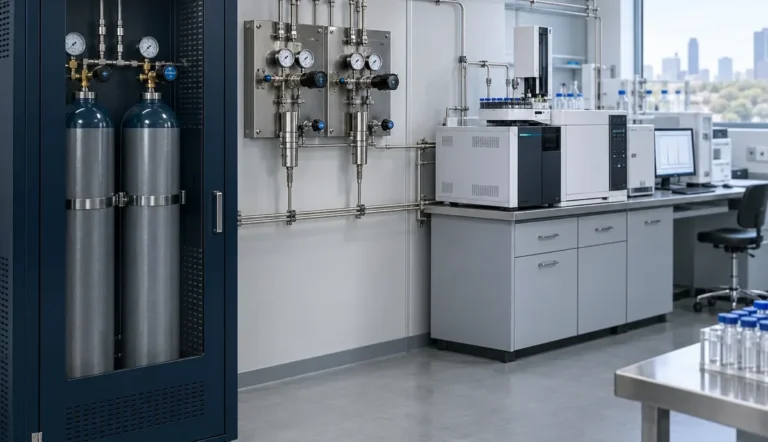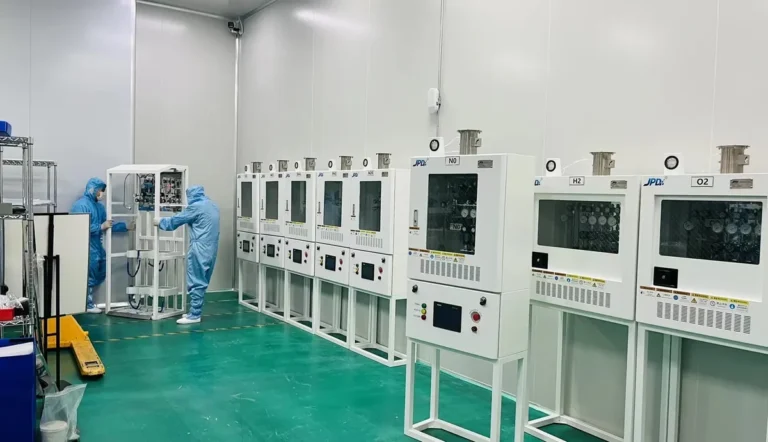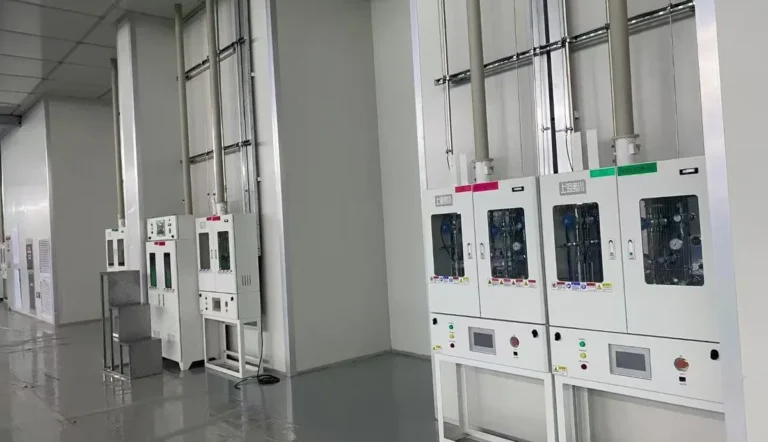

Quick answer: A laboratory specialty gas cabinet is a ventilated steel enclosure that holds one to three gas cylinders together with the gas panel that controls them. It is kept under negative pressure by a dedicated exhaust connection. Laboratories use gas cabinets for flammable, toxic, corrosive, pyrophoric and other hazardous specialty gases, where a leak must be captured and the supply must be able to shut down automatically. The main selection decisions are the gas hazard class, the control level (manual, semi-automatic or fully automatic), the purge method, the exhaust capacity, the purity grade of the wetted parts, and the safety interlocks.
What this guide covers: the types of specialty gas cabinets, the features that separate a compliant cabinet from a steel box, how to match a cabinet to a gas, and the information a buyer should put in a request for quotation. For the wider gas supply system around the cabinet, see the laboratory gas delivery systems guide.
What is a laboratory specialty gas cabinet?
A laboratory specialty gas cabinet is an engineered enclosure that contains hazardous gas cylinders and their pressure-control equipment inside a continuously exhausted space. The cabinet has three jobs. It contains any leak from the cylinder valve, regulator or fittings and carries it away through the exhaust duct. It separates the cylinder from people and from incompatible materials. It also provides a controlled point where the gas supply can be isolated, purged and shut off. A plain cylinder storage cupboard does only the second job. A true gas cabinet does all three.
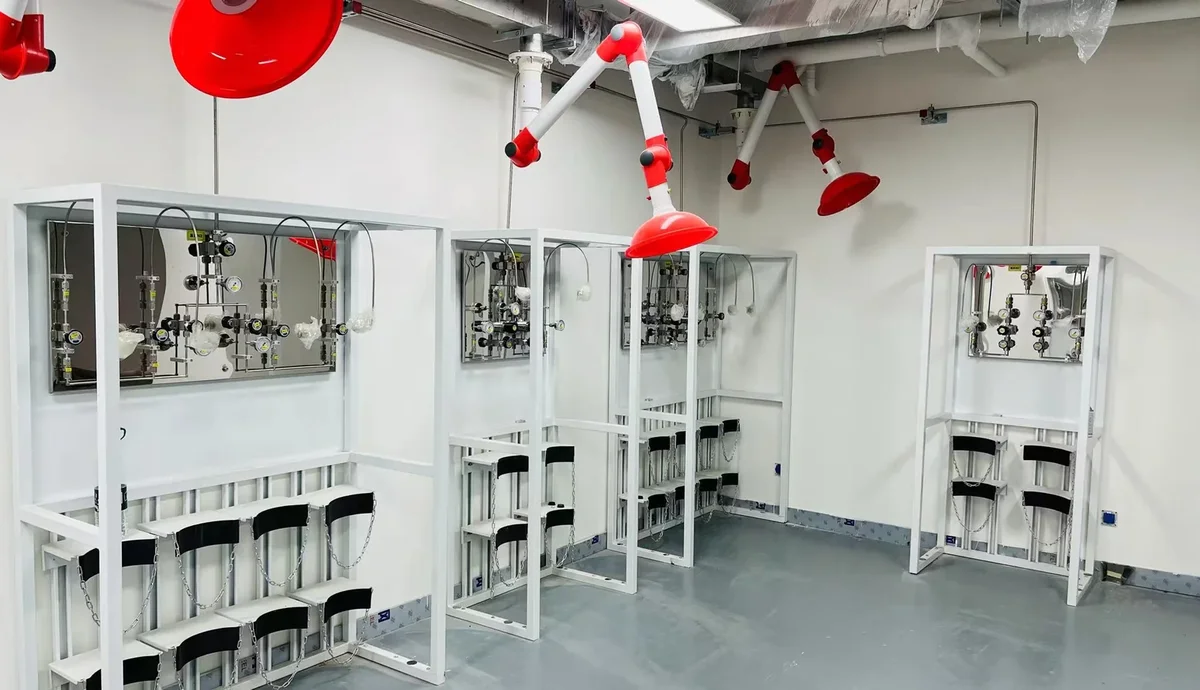
A gas cabinet is different from an open gas rack, a valve manifold box and a cylinder manifold. An open rack supports cylinders and a panel but does not enclose them, so it relies on room ventilation. A valve manifold box (VMB) is an exhausted enclosure that splits one supply line into several branches downstream of the source. It contains no cylinders. A laboratory gas manifold connects banks of cylinders for changeover and is often used for inert or lower-hazard gases where full enclosure is not needed.
Which types of specialty gas cabinets are available?
Specialty gas cabinets are usually classified by function, by the number of cylinders, and by the level of automation. The table below compares the main functional types used in laboratories and pilot lines.
| Cabinet type | What it does | Typical gases | Main limitation |
|---|---|---|---|
| Ventilated cylinder storage cabinet | Restrains and ventilates stored or in-use cylinders; usually no integrated gas panel | Inert gases, calibration mixtures, low-hazard cylinders | No automatic shutoff or purge; not intended for toxic or pyrophoric service |
| Exhausted gas cabinet with manual panel | Encloses cylinders and a manual regulator and purge panel under exhaust | Flammable gases such as hydrogen and methane, low-volume corrosive gases | Relies on operator procedure for purge and changeover |
| Semi-automatic gas cabinet | Adds pneumatic valves, pressure monitoring and automatic shutdown on alarm; purge steps are operator-initiated | Flammable, corrosive and toxic gases in research labs | Purge quality still depends on the operator following the sequence |
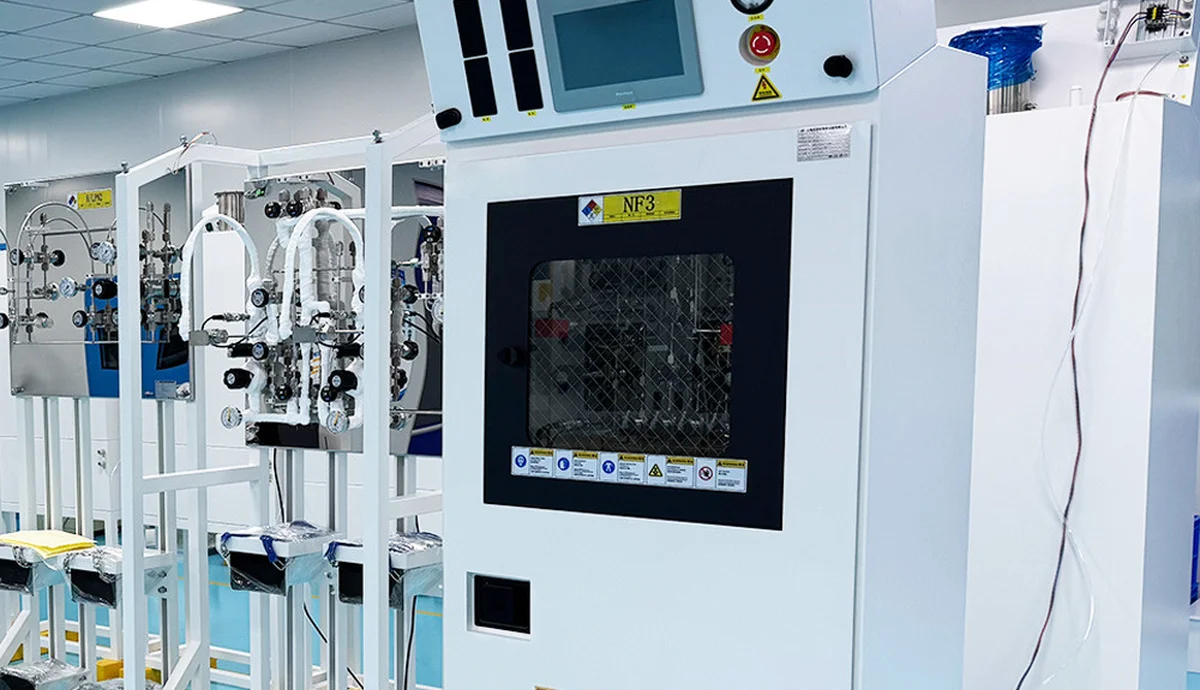
| Fully automatic gas cabinet | PLC or controller runs purge, cylinder change, leak checks and shutdown sequences with a touchscreen interface | Toxic, pyrophoric and high-purity process gases, such as silane, ammonia, chlorine and NF3 | Highest cost; needs utilities, controls integration and trained users |
| Clean-connection cabinet | Exhausted enclosure for connecting and purging lines or small sources with minimal contamination | High-purity gases where connection quality is critical | Not a substitute for a full hazardous gas cabinet |
Cabinets are also sold in single-, double- and triple-cylinder versions. A single-cylinder cabinet suits a gas with low consumption, where a short interruption during cylinder change is acceptable. A double-cylinder cabinet usually holds a process cylinder and a purge gas cylinder, or two process cylinders for continuous supply with changeover. Fire codes commonly limit a gas cabinet to three containers, so larger demand is met with more cabinets or a bulk supply system rather than a bigger cabinet.
What is the difference between manual, semi-automatic and fully automatic gas cabinets?
The control level decides how much of the safety and purity outcome depends on the operator rather than on the equipment. Manual cabinets are simple and inexpensive but depend on correct procedure. Fully automatic cabinets enforce the same sequence every time and log what happened. The right level follows the hazard of the gas and how often cylinders are changed.
| Feature | Manual | Semi-automatic | Fully automatic |
|---|---|---|---|
| Valve operation | Hand valves | Pneumatic valves with manual commands | Pneumatic valves controlled by a PLC sequence |
| Purge | Operator-performed | Operator-initiated, partly automated | Programmed cycle purge with pressure verification |
| Automatic shutdown | Usually limited to an excess flow device | On gas detection, exhaust loss and emergency stop | On all alarms, with event logging and remote signals |
| Cylinder changeover | Manual | Manual or assisted | Automatic switching between cylinders in double-cylinder versions |
| Best fit | Flammable or inert gases with low use | Most research lab hazardous gases | Toxic, pyrophoric or high-value gases and frequent changes |
Which gases need a gas cabinet instead of an open rack?
The gas hazard class is the most reliable way to decide whether a cabinet is needed. Local fire codes, the gas supplier’s safety data sheet and the facility’s risk assessment make the final decision. The general pattern in laboratory practice is shown below.
- Inert gases (nitrogen, argon, helium, carbon dioxide): Usually supplied from open racks or manifolds with oxygen-depletion monitoring in the room. A cabinet is rarely required for hazard reasons, but it may be chosen for purity or space reasons.
- Flammable gases (hydrogen, methane, acetylene, propane): Often installed in exhausted cabinets or dedicated gas rooms with flammable gas detection. Cabinet exhaust dilutes small leaks below the flammable range. See the flammable gas supply system solution for the full path.
- Toxic and corrosive gases (ammonia, chlorine, hydrogen chloride, hydrogen sulfide): Normally require an exhausted cabinet, gas detection, automatic shutoff and frequently exhaust treatment. Material compatibility and moisture control are critical. See the corrosive and high-purity specialty gas supply solution.
- Pyrophoric gases (silane): Ignite on contact with air, so they need a fully automatic cabinet, much higher exhaust flow, flame detection, an internal sprinkler where codes require it, and a strict purge sequence.
- Oxidizers (oxygen, nitrous oxide, NF3): Must be separated from flammable gases and need oxygen-clean components. NF3 is also toxic and is normally treated as a cabinet gas.
Incompatible gases must not share a cabinet. A flammable gas and an oxidizer, or an acid gas and ammonia, belong in separate cabinets, even when each uses only one cylinder.
What construction features define a compliant gas cabinet?
In jurisdictions that adopt the International Fire Code or NFPA 55, gas cabinet requirements follow a consistent pattern. Buyers in other regions often use the same features as a benchmark because they describe a well-performing enclosure. The adopted local code always takes precedence. Typical requirements include:
- Steel construction: Not less than 12-gauge steel, often specified as heavier 11-gauge welded steel for rigidity.
- Self-closing doors and access ports: Doors close and latch automatically. A small self-closing access window lets operators reach the controls without opening the main door.
- Negative pressure: The cabinet is kept below the pressure of the surrounding room and connected to an exhaust system.
- Face velocity at the access port: Commonly at least 200 feet per minute (about 1.0 m/s) on average with the window open, and not less than 150 feet per minute (about 0.76 m/s) at any point.
- Container limit: No more than three cylinders per cabinet.
- Internal sprinkler: Required by NFPA 55 for cabinets that contain toxic, highly toxic or pyrophoric gases.
- Room exhaust: The room containing the cabinet must have its own exhaust. The cabinet cannot be the room’s only exhaust path.
Practical features matter as much as code features. Cylinder restraints should fit the actual cylinder sizes. The window should be safety glass or wired glass so gauges can be read without opening the door. The interior should allow access to fittings for leak checks. A low-level air inlet should sweep air across the cylinder valves, where most leaks start.
How much exhaust does a gas cabinet need?
Exhaust capacity is set by the access-port face velocity, the cabinet size and the gas hazard. It is not chosen freely. A typical one- or two-cylinder cabinet for general hazardous gases may be designed around an exhaust flow in the order of 200 m³/h. A pyrophoric gas such as silane may require roughly four times that, around 800 m³/h. The higher flow dilutes and removes a released gas before it can accumulate. Duct connections of about 150 mm diameter are common. The cabinet manufacturer’s data sheet should state the required flow and static pressure at the duct collar.
The building exhaust has to deliver that flow reliably, around the clock. A cabinet should include an exhaust pressure switch or flow sensor that alarms and shuts off the gas supply if exhaust is lost. Exhaust from toxic or corrosive gas cabinets is commonly routed to an exhaust treatment system, such as a wet, dry adsorption or thermal scrubber, before discharge. The exhaust treatment and purge solution describes how these interfaces are planned.
Which components are inside a specialty gas cabinet panel?
The gas panel inside the cabinet determines both safety and purity. A typical hazardous specialty gas panel includes:
- a CGA, DIN or other cylinder connection matched to the gas
- a high-pressure isolation valve and an inlet filter
- a high-purity pressure regulator
- high- and low-pressure transducers or gauges
- an excess flow valve or flow switch
- a pneumatic emergency shutoff valve
- process outlet and vent valves
- a purge gas inlet with a check valve to prevent backflow into the purge supply
Flammable gas panels often add a flashback arrestor. Liquefied gases with low vapour pressure may need cylinder heating jackets to maintain flow.
For high-purity service, wetted components are typically 316L stainless steel with an electropolished interior. They use face-seal (VCR-type) connections and diaphragm valves rather than packed valves, because diaphragm valves have no packing that can trap or release contamination. Panel leak integrity is commonly verified by helium leak testing. Ultra-high-purity systems typically specify a helium leak rate of 1 × 10⁻⁹ mbar·L/s or tighter. Related components include UHP high-purity gas regulators and high-purity diaphragm valves and fittings.
Which purge method should a gas cabinet use?
Purging removes process gas from the panel before a cylinder change and removes air and moisture before the new cylinder is opened. The purge method has a direct effect on operator exposure, gas purity and the time a cylinder change takes.
| Purge method | How it works | Strengths | Limitations |
|---|---|---|---|
| Manual flow purge | Operator flows inert gas through the panel to vent | Simple, low cost | Dead legs are hard to clear; depends on operator discipline |
| Pressure cycle purge | Panel is repeatedly pressurized with inert gas and vented | Effective for dead legs; can be automated | Needs more purge gas and time per change |
| Vacuum-assisted (venturi) cycle purge | A venturi vacuum generator evacuates the panel between inert gas fills | Fastest removal of residual gas and moisture; best for toxic and pyrophoric gases | Requires a venturi drive gas supply and vented exhaust connection |
| Dedicated purge cylinder inside the cabinet | Inert purge gas is supplied from a cylinder in the same cabinet | Prevents hazardous gas backflow into a shared purge line | Uses a cylinder position; purge cylinder must be monitored |
For toxic, corrosive and pyrophoric gases, the common practice is a dedicated purge source and an automated cycle purge with pressure verification at each step. A shared house nitrogen line should not be connected directly to a hazardous gas panel unless backflow protection is engineered and verified.
Which monitoring and shutdown functions should a gas cabinet include?
Monitoring turns a gas cabinet from passive containment into an active safety system. The minimum functions are usually set by the hazard of the gas:
- Gas detection: Sampling inside the cabinet exhaust or at the panel, linked to automatic shutoff of the pneumatic valve.
- Exhaust monitoring: A pressure switch or flow sensor in the cabinet exhaust.
- Excess flow protection: Stops gas flow if a downstream line breaks.
- Emergency stop: A button on the cabinet, plus remote emergency stops at room exits.
- Flame detection: UV/IR flame detection for pyrophoric and some flammable gases.
- Interfaces: Connections to the fire alarm panel and the building management system.
- Event logging: Records alarms, cylinder changes and purge cycles.
Room-level detection is still needed alongside cabinet detection. Detection inside the cabinet finds a leak at the source. Room detectors find leaks in the distribution line and at the point of use. Products for this layer are grouped under gas monitoring and safety systems.
How does a gas cabinet compare with an open rack or a central gas room?
A gas cabinet, an open gas rack and a central gas room are three different ways to locate and protect a gas source. The choice depends on gas hazard, number of gases and building layout.
| Criterion | Exhausted gas cabinet | Open gas rack or manifold | Central gas room |
|---|---|---|---|
| Leak containment | High; captured at the source | Low; depends on room ventilation | Medium to high; room-level ventilation and detection |
| Suitable gases | Toxic, corrosive, pyrophoric, flammable, high-purity | Inert and lower-hazard gases | Many gases, often combined with cabinets for hazardous ones |
| Footprint | About 0.6–0.8 m wide per cabinet | Small per cylinder | Requires a dedicated room |
| Utilities needed | Exhaust, power, purge gas, alarms | Minimal | Room exhaust, detection, fire separation |
| Typical capital cost | Highest per cylinder | Lowest | High building cost, low per-gas cost at scale |
Many laboratories combine the approaches. Inert gases are supplied from central manifolds, and hazardous specialty gases come from exhausted cabinets close to the instruments that use them. The trade-offs between local and central supply are covered in centralized vs cylinder-at-bench gas supply.
How should a gas cabinet be sized for cylinders and space?
Gas cabinet sizing starts with the cylinder, not the cabinet. Confirm the cylinder size, height and valve type used by the local gas supplier, then the number of cylinder positions. As an example, a single-cylinder cabinet may measure about 600 mm wide, 660 mm deep and 2100 mm high. A double-cylinder cabinet may measure about 800 mm wide, 630 mm deep and 2170 mm high. Allow front clearance for the door swing and cylinder handling, side clearance for maintenance, and overhead clearance for the exhaust duct.
Consumption determines whether one or two process cylinders are needed. If a cylinder lasts months and a planned interruption is acceptable, one process cylinder plus a purge cylinder is sufficient. If the instrument or process cannot tolerate an interruption, a double-cylinder cabinet with automatic changeover keeps supply continuous. Utilities also affect sizing. Automatic cabinets typically need a 220 VAC control supply, clean dry air or nitrogen for pneumatic valves, and additional heating power if cylinder heaters are used.
Which laboratory applications use specialty gas cabinets most often?
Gas cabinets appear wherever hazardous or high-value gases are used outside a production fab. Common laboratory applications include:
- Semiconductor and microelectronics research: Silane, ammonia, chlorine and fluorinated gases for deposition and etch tools. See the semiconductor research specialty gas delivery case.
- University and research institute laboratories: Mixed gas lists in shared buildings, where cabinets let hazardous gases be placed safely near users. See the university laboratory specialty gas upgrade.
- Hydrogen and fuel cell testing: Hydrogen supply with flammable gas detection and automatic shutoff. See the hydrogen fuel cell laboratory case.
- Analytical and environmental testing laboratories: Calibration mixtures and toxic standards, often in small cylinders.
- Photovoltaic and materials research: Process gases for thin-film and advanced materials work.
How should a new gas cabinet be installed and commissioned?
Commissioning proves that the installed cabinet contains gas, controls pressure and shuts down as designed. A complete commissioning record usually includes:
- Exhaust verification: Measure face velocity across a grid at the access window and run a smoke capture check.
- Leak testing: Pressure decay and helium leak testing of the panel and connections.
- Purity verification: For high-purity service, test moisture, oxygen and particles at the outlet.
- Functional tests: Confirm that each alarm, including gas detection, exhaust loss, excess flow and emergency stop, closes the shutoff valve and sends the right signal.
- Handover: Train users on the cylinder change and purge procedure.
The documents should be kept with the cabinet for future inspections. Practical installation steps are described in the laboratory specialty gas installation guidelines.
What maintenance keeps a gas cabinet safe over its service life?
Gas cabinet safety depends on maintenance as much as design. Gas detectors drift and need calibration at the interval the manufacturer specifies. Exhaust performance changes as dampers and fans age. Regulator seats, filters and cylinder connection gaskets wear with repeated cylinder changes. A practical program includes:
- a visual check and leak check at every cylinder change
- periodic face velocity measurement
- detector calibration and functional testing of every shutdown path
- replacement of consumable gaskets and filters
- a documented annual inspection
See after-sales maintenance and annual inspection for a service framework.
What are the most common mistakes when selecting a gas cabinet?
Most gas cabinet problems come from specification gaps rather than from equipment failure. The mistakes that appear most often in laboratory projects are:
- Selecting by cylinder count only: The cabinet is chosen by cylinder count, while the gas hazard class, which drives the exhaust, purge and shutdown requirements, is ignored.
- Underestimating exhaust: The building exhaust cannot supply the flow and static pressure the cabinet needs, or has no backup.
- Sharing purge gas unsafely: A house nitrogen line is used as the purge supply without backflow protection.
- Mixing incompatible gases: Incompatible gases are placed in the same cabinet or the same exhaust branch without review.
- Wrong materials: Brass or packed valves are used on corrosive or high-purity service where 316L and diaphragm valves are required.
- Missing interlocks: The fire alarm, building management system or emergency stop wiring is left out of the electrical scope.
- Omitting supplier details: The cylinder connection standard and cylinder sizes of the local gas supplier are not specified.
What should a B2B buyer include in a gas cabinet RFQ?
A complete RFQ lets suppliers quote comparable equipment and prevents costly changes after order. A gas cabinet request should state:
- Gas data: Gas name, purity grade and hazard class.
- Cylinders: Cylinder size, connection standard and number of positions.
- Delivery conditions: Delivery pressure range and peak and average flow.
- Control and purge: Control level and purge method.
- Safety functions: Required detection, interlocks and signals to building systems.
- Utilities: Exhaust capacity available, electrical supply, and pneumatic and purge gas supplies.
- Treatment: Exhaust treatment requirements for toxic or corrosive gases.
- Purity and testing: Wetted materials, surface finish and leak test criteria.
- Codes: Applicable codes and the authority that will approve the installation.
- Site constraints: Space limits, door widths and installation location.
- Documents: Factory test reports, drawings and operating manuals.
For help organizing these inputs across a whole system, see the laboratory gas product selection guide and how to choose laboratory gas piping and fittings.
How should buyers compare gas cabinet costs?
Gas cabinet cost should be compared over the life of the installation, not by the cabinet price alone. The capital price is driven by the control level, the number of cylinder positions, the purity grade of the panel, and the detection and interlock scope. Lifetime cost also includes:
- exhaust energy, which runs continuously
- purge gas consumption
- detector calibration and replacement
- spare parts
- downtime during cylinder changes
- the cost of an incident or contaminated process
A fully automatic cabinet costs more to buy but can reduce purge gas use, operator time and the risk of contamination. That makes it the lower-cost option for toxic gases or frequent cylinder changes.
Frequently asked questions
How many cylinders can a gas cabinet hold?
Fire codes such as NFPA 55 commonly limit a gas cabinet to three cylinders. Most laboratory specialty gas cabinets are built for one, two or three cylinders. Double-cylinder versions are the most common because they hold a process cylinder plus a purge cylinder, or two process cylinders for changeover.
Does a hydrogen cylinder need a gas cabinet?
It depends on the quantity, the room and the local code. Small hydrogen quantities in a well-ventilated laboratory may be allowed on an open rack with detection. Many facilities still choose an exhausted cabinet with hydrogen detection and automatic shutoff, because it contains leaks at the source and simplifies approval.
Can two different gases share one gas cabinet?
Only compatible gases should share a cabinet, and many facilities limit each cabinet to one process gas plus its inert purge gas. Incompatible gases, such as a flammable gas and an oxidizer, must be placed in separate cabinets.
What is the difference between a gas cabinet and a VMB?
A gas cabinet encloses the gas cylinders and the source panel. A valve manifold box is installed downstream to distribute gas from one supply line to several points of use, and it contains valves but no cylinders. Both are exhausted enclosures, and a hazardous gas system often uses both.
How often should a gas cabinet be inspected?
Leak checks should be made at every cylinder change. Gas detectors should be calibrated at the manufacturer’s interval, and face velocity and all shutdown functions should be verified at least annually or as the local authority requires.
Plan a laboratory specialty gas cabinet project with LGF
LGF Lab Gas Flow supplies laboratory specialty gas cabinets and the equipment around them. The cabinet range includes the JW-200-GC semi-automatic specialty gas cabinet and the JW-300-GC fully automated specialty gas cabinet, alongside clean-connection cabinets, valve manifold boxes, gas racks and gas scrubbers for exhaust treatment. Because LGF covers the source, distribution and point-of-use equipment, the cabinet interfaces can be reviewed together with the piping, regulators and safety systems instead of as an isolated purchase.
For a B2B quotation, send the gas list with hazard classes, purity grades, cylinder sizes, pressure and flow requirements, preferred control level, available exhaust and utilities, required interlocks, the project location and the expected order quantity. The LGF team can propose a suitable cabinet configuration and confirm drawings and options for your application. Contact LGF to discuss a specialty gas cabinet purchase, a distributor partnership or a complete laboratory gas delivery project.