
Quick answer: Before buying a laboratory gas regulator, check ten things:
- the role the regulator will play: cylinder, line or point-of-use
- the exact gas and purity grade
- the cylinder connection standard for your country and gas
- the inlet and outlet pressure ranges, including gauge scales
- the flow capacity at your working pressure
- body, diaphragm and seat materials
- leak integrity and surface finish for high purity work
- outlet connections and port configuration
- safety features such as relief valves and venting design
- documentation, spare parts and service support
A regulator that matches all ten points delivers stable pressure, keeps gas clean and lasts for years. A regulator chosen only by price or appearance often causes drift, contamination or leaks.
How this guide differs from a regulator comparison: it is a pre-purchase checklist covering the details buyers most often miss. For the choice between single-stage and two-stage designs, see single-stage vs two-stage gas regulators.
Which role will the regulator play in the gas system?
The first check is the position of the regulator in the gas path, because each position needs a different design:
- Cylinder regulator: Connects directly to a gas cylinder and reduces full cylinder pressure, often up to 200 or 300 bar, to a working pressure.
- Line regulator: Sits in a pipeline and reduces an already regulated supply pressure to a lower, more precise value for a room or bench.
- Point-of-use regulator: Mounted at the instrument or on a bench panel. It provides the final, stable pressure for a gas chromatograph, mass spectrometer or other instrument.
- Panel or manifold regulator: Built into changeover manifolds and gas cabinets.
Buying the wrong type is a common and expensive mistake. A line regulator installed on a cylinder will be exposed to pressures beyond its rating, and a cylinder regulator used as a point-of-use regulator may not give the fine control an instrument needs. Write down the inlet pressure the regulator will see, the outlet pressure it must deliver and where it will be mounted before comparing models. Typical layouts are shown in the laboratory gas delivery systems guide.
Which gas and purity grade will the regulator handle?
The gas and purity grade decide materials, cleaning and design. Inert gases such as nitrogen, argon and helium are the least demanding, although high purity grades still need clean, low-outgassing designs. Flammable gases such as hydrogen and methane need leak-tight construction and matching safety devices. Oxidising gases such as oxygen and nitrous oxide need oxygen-clean components and compatible seat materials. Corrosive and toxic gases such as ammonia, chlorine and hydrogen chloride need corrosion-resistant materials, tied diaphragms and purge arrangements.
Purity grade matters as much as gas identity. A regulator used for 99.999% helium carrier gas in a gas chromatograph must not add moisture, oxygen or hydrocarbons to the gas stream. That requires a stainless steel diaphragm, clean internal surfaces and a tight leak rate. A regulator for a utility-grade gas used for purging can use simpler materials. Matching the regulator to the purity grade avoids both contamination and paying for capability that is not needed.
Which cylinder connection does the regulator need?
The cylinder connection must match the cylinder valve outlet used in the country and for the specific gas. Connection standards differ by region:
- CGA: Used in North America. Examples are CGA 580 for inert gases, CGA 350 for hydrogen and many flammable gases, CGA 540 for oxygen, CGA 320 for carbon dioxide and CGA 346 for air.
- DIN 477: Used in Germany and many European countries.
- BS 341: Used in the United Kingdom.
- National standards: Japan, China and other countries have their own cylinder valve outlet standards.
Connection standards are designed so that incompatible gases cannot be connected by mistake. A regulator with the wrong connection either will not fit, or worse, is forced to fit with an adapter that defeats this safety feature. The correct connection should be specified on the order by gas and country, and the gas supplier can confirm the cylinder valve outlet. Some connections seal metal to metal, while others use a replaceable gasket or washer that must be kept in stock.
Which pressure ranges and gauge scales should be selected?
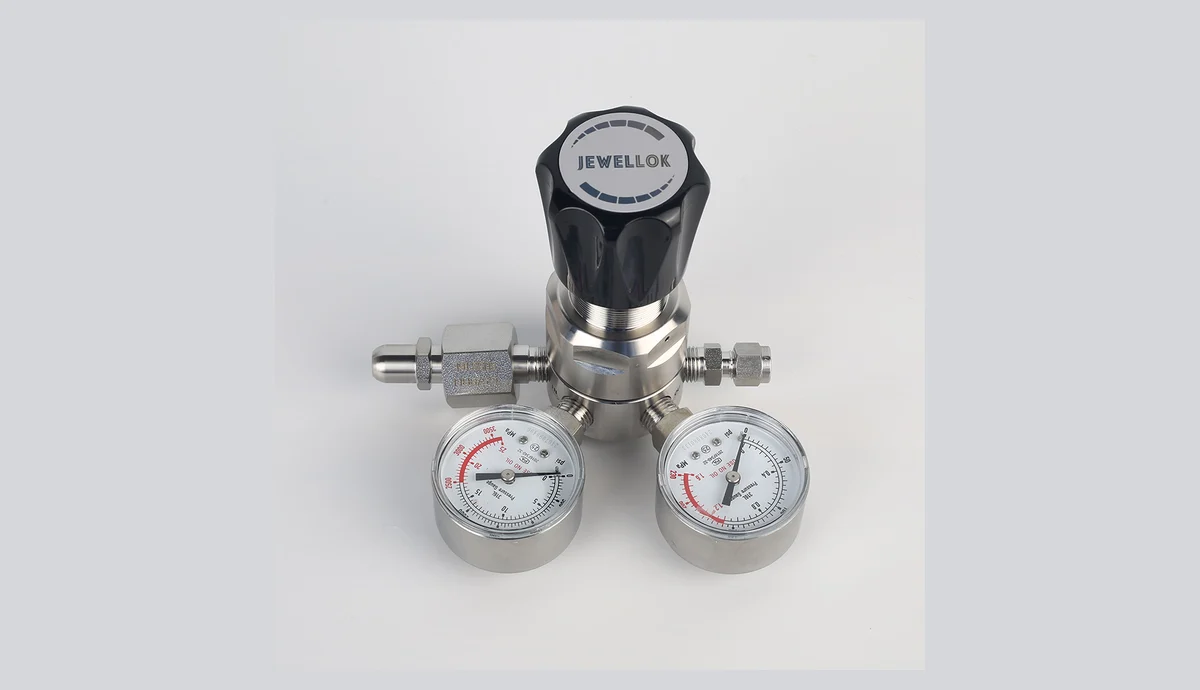
Pressure ranges should be chosen so the regulator works in the most accurate part of its range:
- Inlet: The maximum inlet pressure must exceed the highest pressure the regulator can see, such as a full cylinder.
- Outlet: The outlet range should place the normal setpoint roughly in the middle of the range, between about 20% and 80% of full scale. A regulator with a 0-10 bar outlet range adjusts a 1 bar setpoint far less precisely than a regulator with a 0-4 bar range.
- Gauges: Gauge scales follow the same logic. The inlet gauge should comfortably exceed full cylinder pressure, so it also shows cylinder contents. The outlet gauge should read the working pressure in its middle third, where it is easiest to read and most accurate.
Dual-scale gauges in bar, psi or MPa help when users work with different units. Gauge size, accuracy class and the material of wetted parts should match the purity and readability needs of the application.
How do you check that the regulator can deliver enough flow?
Flow capacity is often overlooked because regulators are bought by pressure range alone. Every regulator has a flow curve, which shows how outlet pressure falls as flow increases. This fall in pressure is called droop. A regulator with too little capacity for the instrument flow will drop below its setpoint whenever demand rises. That causes unstable baselines in chromatography or poor performance in other instruments.
Ask the supplier for the flow curve at your inlet and outlet pressures, or for the flow coefficient (Cv) of the regulator. Compare it with the peak flow of the instrument or the combined flow of every user downstream. Gases such as carbon dioxide at high flow can cool the regulator strongly as they expand, and may need a heated regulator to prevent freezing. Droop, creep and supply pressure effect are explained in more detail in single-stage vs two-stage gas regulators.
Which body, diaphragm and seat materials are right for the gas?
Material choice decides compatibility, purity and service life. The common combinations are:
| Component | Option | Best suited to | Limitations |
|---|---|---|---|
| Body | Chrome-plated or bare brass | Inert and non-corrosive gases, general laboratory use | Not for corrosive gases or ultra-high purity service |
| Body | 316L stainless steel | High purity, corrosive and toxic gases | Higher cost |
| Diaphragm | Stainless steel | High purity applications; low outgassing and permeation | Higher cost than elastomer diaphragms |
| Diaphragm | Elastomer | General purpose, low purity gases | Permeation and outgassing affect purity |
| Seat | PCTFE | Most laboratory gases, including oxygen service | Temperature limits |
| Seat | PTFE or PEEK | Specific chemical or temperature requirements | Check compatibility for each gas |
Seals and O-rings must also be compatible with the gas. For oxygen and other oxidisers, every wetted part must be cleaned for oxygen service and lubricated, if at all, only with oxygen-compatible lubricants. For corrosive gases, a stainless steel body with a tied diaphragm resists corrosion and prevents the diaphragm from being drawn into the seat during purging.
Which leak rate and surface finish matter for high purity gases?
For high purity and ultra-high purity gases, leak integrity and internal surface finish protect the gas from contamination. Inboard leakage allows air and moisture into the gas stream even when the regulator holds pressure. High purity regulators are therefore tested with helium and specified with leak rates such as 1 x 10⁻⁸ or 1 x 10⁻⁹ mbar l/s. Ask for the tested leak rate and the test method.
Internal surface finish affects how much moisture and contamination the regulator holds and releases. Electropolished stainless steel surfaces with low roughness give fast dry-down and low particle generation. The internal volume and dead space also matter, because large dead volumes take longer to purge. For gas chromatography, trace analysis and semiconductor research, these specifications are as important as pressure range. The UHP high purity gas regulator range shows typical construction for these applications.
Which connections and port configuration should be specified?
Outlet connections and ports should match the tubing and fittings used in the laboratory. Common outlet options are 1/8 in or 1/4 in compression fittings, metric tube fittings, face-seal fittings for ultra-high purity lines, and threaded ports. The regulator should also have enough ports, in the right positions, for gauges, a relief valve or a purge connection. Port positions affect how easily the regulator can be mounted on a panel and how the tubing is routed.
Buyers often forget accessories that make the regulator usable on arrival: outlet shut-off valves, check valves, purge tees and mounting brackets. Ordering them as a matched assembly avoids mixing materials and connection types, which can create leak points. Fitting and tubing choices are covered in how to choose laboratory gas piping and fittings.
Which safety features should a laboratory gas regulator have?
Safety features protect people, instruments and downstream equipment:
- Relief valve: On the outlet side, prevents overpressure if the seat leaks or the regulator is set too high. It should vent safely, away from people.
- Venting design: Self-venting regulators release gas when the setpoint is reduced. That is acceptable for inert gases but not for toxic or flammable gases, which need non-venting designs.
- Diaphragm design: Tied diaphragms improve safety and performance for corrosive gases and vacuum purging.
- Flow restriction: Restricted flow orifices or excess flow devices limit the release rate if a downstream line breaks.
- Gas-specific limits: Some gases have outlet pressure limits. Acetylene, for example, must not be delivered above about 1 bar, so its regulators are built with limited outlet ranges.
Flammable gas regulators are normally combined with check valves and flashback arrestors in the gas line. Toxic and corrosive gas regulators are usually installed inside exhausted gas cabinets with purge assemblies. Hazard-specific requirements are summarised in NFPA compliance for laboratory gas hardware.
Which gases need a specialty regulator?
Some laboratory gases need regulators with special features rather than a standard design:
- Carbon dioxide: At high flow, CO2 cools strongly as it expands and can freeze the regulator seat. Heated regulators or high-capacity designs prevent this.
- Corrosive gases: Ammonia, chlorine and hydrogen chloride need stainless steel construction, tied diaphragms and an integrated purge assembly, so the regulator can be purged with inert gas before and after cylinder changes.
- Oxygen and nitrous oxide: Need oxygen-cleaned regulators with compatible seats and no hydrocarbon contamination.
- Acetylene: Needs a regulator with a limited outlet range and connections designed for that gas.
- Calibration gas mixtures: Mixtures in small cylinders often use compact regulators with low internal volume, to save gas and stabilise quickly.
- Ultra-low pressure delivery: Some instruments need very low delivery pressures, which call for low-pressure line regulators with sensitive diaphragms.
When a laboratory uses several of these gases, a family of regulators from one supplier simplifies spare parts and training. Each regulator still has the features its gas requires, but the connections, gauges and service procedures stay consistent across the laboratory. That reduces the chance of a wrong part being fitted during maintenance and makes cylinder change procedures easier to teach.
Which documents and markings should come with the regulator?
A laboratory gas regulator should arrive with clear identification and documentation:
- the model number
- the gas service
- inlet and outlet pressure ratings
- the connection type
- material and cleaning information
- the test certificate showing pressure and leak testing
- installation and operating instructions
- a spare parts list
High purity and oxygen-service regulators should state their cleaning standard and be delivered capped and bagged to keep internal surfaces clean.
Markings on the regulator body and gauges should match the documentation. A regulator labelled for one gas should not be moved to another gas service without cleaning and re-certification, because residues and seat materials may be incompatible. Good documentation also makes audits and safety inspections easier, because the laboratory can show that each regulator is rated for its use.
How should regulators be inspected and tested on delivery?
Incoming inspection catches problems before a regulator is connected to a gas supply. A practical inspection includes:
- checking the model, connection and pressure ratings against the order
- confirming that the gauge ranges and units are correct
- inspecting the packaging, caps and cleanliness
- checking the test certificate
After installation, a leak test with an appropriate method, a check that the regulator holds its setpoint without creeping upward, and a functional check of the relief valve confirm that it is ready for use.
Creep is an important test. When flow stops, outlet pressure should stay steady. A slow, continuous rise in outlet pressure indicates a seat leak, which can over-pressurise instruments. Recording these checks for each regulator creates a simple baseline for future maintenance and troubleshooting.
Which service and lifecycle factors should influence the purchase?
A laboratory gas regulator is a long-life component when it can be serviced. Before buying, check:
- whether repair kits with seats, diaphragms and seals are available
- whether the supplier can rebuild and re-test regulators
- how long spare parts will be supplied
- the warranty terms
Regulators in corrosive service wear faster and benefit from planned replacement of seats and diaphragms.
Lifetime cost includes the purchase price, gas lost through leaks or self-venting, downtime caused by drift or failure, and the cost of service. A slightly more expensive regulator with a better seat design, a tighter leak rate and local service support often costs less over ten years than a cheaper model replaced every few years. Annual inspection programs, such as after-sales maintenance and annual inspection, keep regulators performing as specified.
What does a complete laboratory gas regulator checklist look like?
| Check | What to confirm |
|---|---|
| Role | Cylinder, line, point-of-use or panel regulator |
| Gas and purity | Exact gas, purity grade and hazard class |
| Cylinder connection | Correct national standard and gas-specific outlet |
| Pressure ranges | Inlet rating above maximum supply; setpoint in mid outlet range |
| Gauges | Scales, units and accuracy suited to the working pressure |
| Flow | Flow curve or Cv adequate for peak demand |
| Materials | Body, diaphragm, seat and seals compatible with the gas |
| Purity specifications | Helium leak rate, surface finish, dead volume |
| Connections | Outlet fittings and ports matching the tubing system |
| Safety | Relief valve, venting design, tied diaphragm, flow restriction |
| Documentation | Test certificate, cleaning standard, manuals, spare parts list |
| Service | Repair kits, rebuild service, warranty |
What are the most common mistakes when buying laboratory gas regulators?
The mistakes that most often lead to poor performance or safety problems are:
- Wrong regulator type: Choosing a regulator type that does not match its position in the system.
- Adapters on cylinders: Using adapters to fit the wrong cylinder connection.
- Oversized outlet range: Choosing an outlet range much larger than the setpoint.
- Ignoring flow: Overlooking flow capacity.
- Brass for high purity: Using brass and elastomer diaphragms for high purity or corrosive gases.
- Self-venting on hazardous gases: Selecting self-venting regulators for toxic or flammable gases.
- No service plan: Buying without spare parts or service support.
Each of these is avoided by completing the checklist above before ordering.
Frequently asked questions
Can one regulator be used for different gases?
Only if the gases are compatible and the regulator materials, cleaning and connection suit both. In practice, regulators should be dedicated to one gas service, because residues, seat materials and connections differ between gases.
Why does my regulator outlet pressure rise slowly when the instrument is off?
A slow rise in outlet pressure with no flow is called creep. It usually indicates a leaking seat, often caused by particles or wear. The regulator should be serviced or replaced to protect the instrument.
Do I need a stainless steel regulator for gas chromatography?
For carrier and detector gases in gas chromatography, a regulator with a stainless steel diaphragm and clean, low-outgassing construction is strongly recommended to protect baseline stability and detector sensitivity.
How often should laboratory gas regulators be serviced?
Regulators should be inspected regularly and checked during annual maintenance. Those in corrosive or heavy-use service need more frequent attention, with seats and diaphragms replaced according to their condition and the recommendations of the manufacturer.
Get the right laboratory gas regulators from LGF
LGF Lab Gas Flow supplies high purity laboratory gas regulators, including cylinder regulators, line regulators, high-flow regulators and gas stick assemblies. It also supplies matching diaphragm valves and fittings, gas manifold and changeover systems, point-of-use systems and specialty gas cabinets. Because regulators are supplied together with the rest of the gas path, connections, materials and purity levels stay consistent from the cylinder to the instrument.
Laboratory managers, contractors and distributors can send their gas list, purity grades, cylinder connection standard, inlet and outlet pressures, flow requirements and instrument types. The LGF team will recommend the right regulators and accessories and provide a quotation. See the laboratory gas product selection guide or contact LGF to discuss your laboratory gas regulator requirements.