
Quick answer: A GC gas cabinet is an exhausted enclosure that holds one to three standard high-pressure cylinders and delivers a hazardous specialty gas to a small number of tools or laboratory instruments. A BSGS (bulk specialty gas supply) cabinet is a larger, heavier-duty delivery system that draws the same type of gas from bulk containers such as Y-cylinders, ton containers, cylinder bundles or tube trailers and feeds a site-wide distribution network. The GC gas cabinet is the right choice when gas consumption is low to moderate and the gas serves a few points of use. The BSGS is the right choice when one gas is consumed at high volume by many tools, when cylinder change-outs become frequent, or when gas cost per unit volume must come down.
What this comparison covers: how the two systems differ in source size, flow capacity, controls, safety design, utilities, risk and total cost; which facilities use each one; how to decide between them; and what a buyer should specify in a request for quotation. For the basic construction of an enclosed cabinet, see the laboratory specialty gas cabinets guide.
What is a GC gas cabinet?
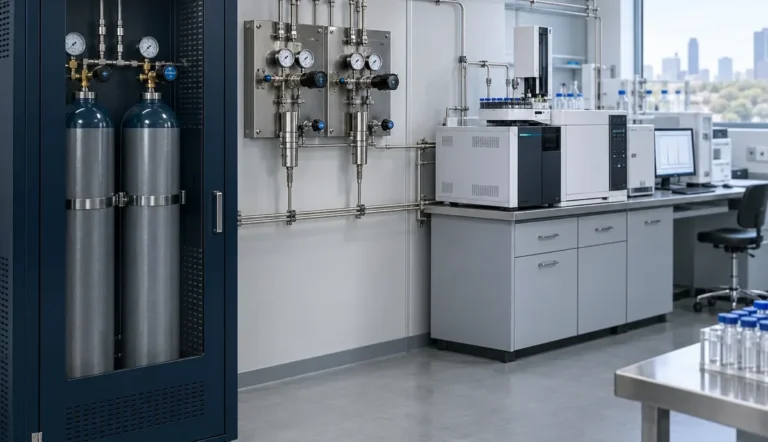
A GC gas cabinet (gas cabinet) is a ventilated steel enclosure that contains standard high-pressure gas cylinders, typically 40 to 50 liter water capacity, together with the gas panel that regulates, purges and isolates each cylinder. The cabinet is held under negative pressure by a dedicated exhaust duct, so a leak from a cylinder valve, pigtail or regulator is captured and carried to exhaust treatment. GC gas cabinets are used for flammable, toxic, corrosive and pyrophoric gases such as hydrogen, silane, ammonia, chlorine, hydrogen chloride and arsine-type dopant mixtures.
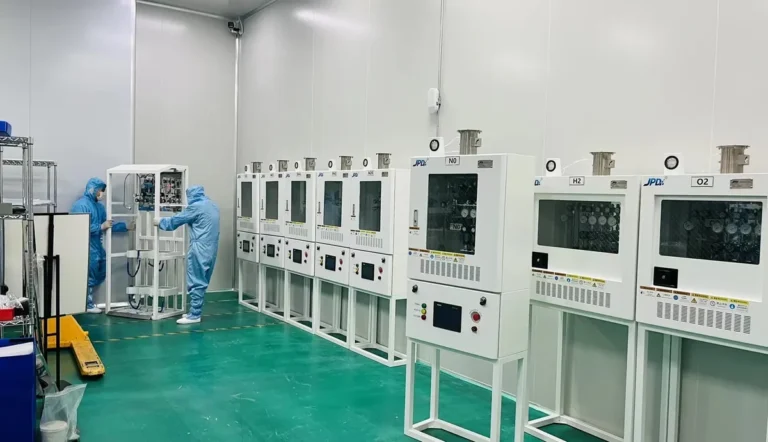
A GC gas cabinet usually comes in a single-cylinder or two-cylinder layout. A two-cylinder GC gas cabinet often holds one process cylinder and one purge-gas cylinder, or two process cylinders with automatic changeover. The control level ranges from manual valves to a semi-automatic or fully automatic PLC with a touchscreen, automatic purge sequences and emergency shutdown. LGF builds both levels, for example the JW-200-GC semi-automatic specialty gas cabinet and the JW-300-GC fully automated specialty gas cabinet, with footprints of roughly W600 × D661 mm for a single-cylinder unit and W800 × D633 mm for a two-cylinder unit.
What is a BSGS gas cabinet?
A BSGS (bulk specialty gas supply) gas cabinet is a high-capacity delivery system that connects a large specialty gas container to a facility distribution header. Typical BSGS sources include Y-cylinders (about 440 to 470 liter water capacity), ton containers, multi-cylinder bundles, ISO modules and tube trailers. Because one bulk container can hold the gas equivalent of 10 to 50 standard cylinders, a single BSGS can supply a whole production bay, a pilot line or a large research building with one gas.
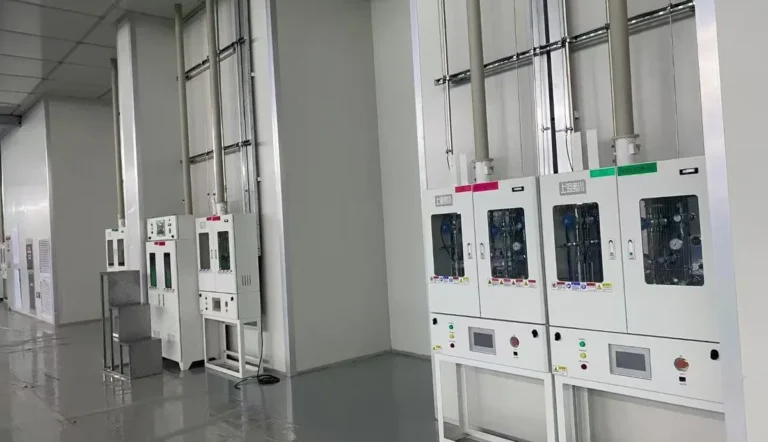
A BSGS normally operates as a pair of sources with automatic switchover, so the distribution header stays pressurized while one container is being replaced. It uses larger-bore high-purity tubing, high-flow regulators, heaters to compensate for Joule-Thomson cooling or vaporization of liquefied gases, weight scales or pressure transducers for source monitoring, and a PLC with remote communication to the facility monitoring system. Downstream, the BSGS header usually feeds valve manifold boxes that split the gas to individual tools. The JW-300-BSGS bulk specialty gas supply skid is an example of this class of equipment.
What is the core difference between a GC gas cabinet and a BSGS?
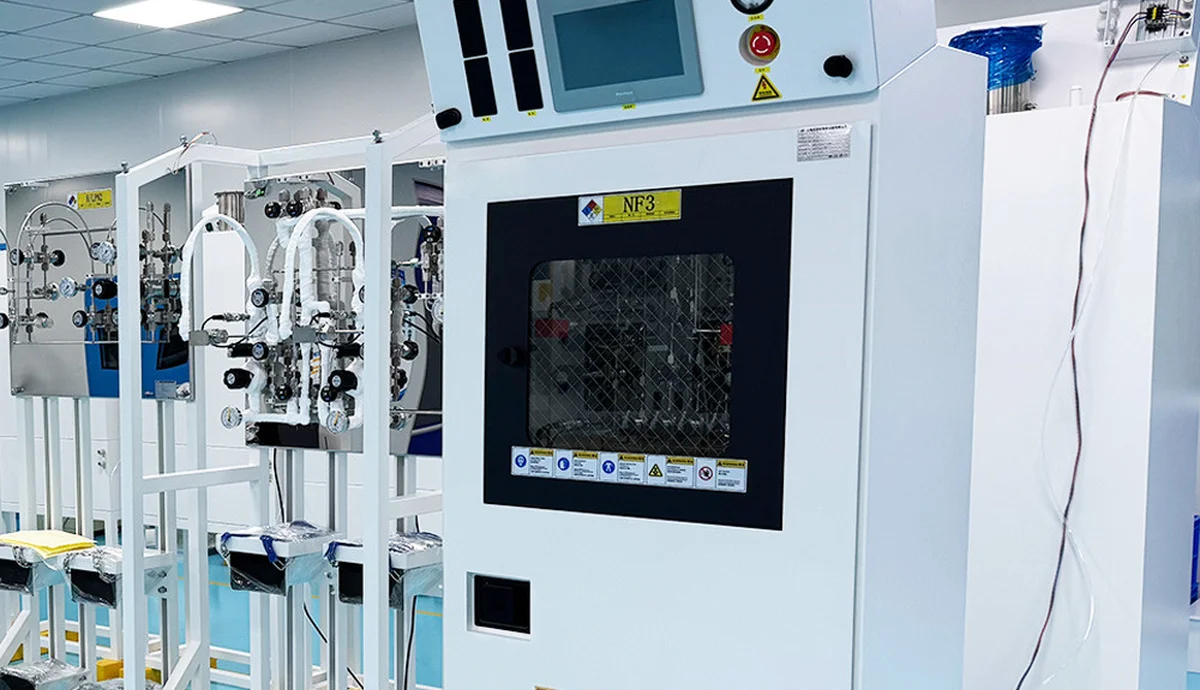
The core difference between a GC gas cabinet and a BSGS is the scale of the gas source and the number of users each system serves. A GC gas cabinet is built around standard cylinders and typically supplies one to a few tools or instruments. A BSGS is built around bulk containers and typically supplies a header that serves many tools, often dozens. Every other difference, including flow capacity, heater power, exhaust volume, control redundancy, footprint, abatement sizing and cost structure, follows from that difference in source scale.
A practical way to frame the choice is to ask how often a cylinder would have to be changed. If a standard cylinder in a GC gas cabinet lasts weeks or months, a GC gas cabinet is efficient. If the same gas would require cylinder changes every few days, or several GC gas cabinets running in parallel for one gas, the facility is already operating at a scale where a BSGS usually becomes safer and cheaper.
How do GC gas cabinets and BSGS systems compare side by side?
The table below compares a GC gas cabinet and a BSGS gas cabinet across the factors that most often decide a project. The values are typical ranges for specialty gas service, and the final design depends on the specific gas, pressure and flow.
| Factor | GC gas cabinet | BSGS gas cabinet |
|---|---|---|
| Gas source | 1–3 standard cylinders (about 40–50 L water capacity) | Y-cylinders, ton containers, bundles, ISO modules or tube trailers |
| Typical users served | 1 to a few tools or instruments | Many tools through a header and valve manifold boxes |
| Flow capacity | Low to moderate, limited by cylinder size and regulator | High, sized for the combined peak demand of the header |
| Change-out frequency | Frequent at high consumption | Up to roughly ten times fewer change-outs for the same gas volume |
| Switchover | Optional, between two cylinders in one cabinet | Standard, between two bulk sources or two paired units |
| Heating | Often none or a small heater for liquefied gases | Engineered heaters and heat tracing sized for flow and ambient conditions |
| Footprint and location | Indoor gas room or service chase | Dedicated gas yard, bulk pad or large gas room, often partly outdoors |
| Handling equipment | Hand cylinder cart | Forklift, crane, pallet jack or trailer access |
| Failure impact | Limited to the tools on that cabinet | Can affect every tool on the header |
| Abatement sizing | Based on release of one standard cylinder | Based on release of one bulk container, so much larger |
| Capital cost | Lower per unit | Higher per unit, but often lower than many parallel GC cabinets |
| Gas cost per unit volume | Higher | Lower, because bulk packaging reduces cost per kilogram or cubic meter |
How does gas consumption decide between a GC gas cabinet and a BSGS?
Gas consumption is the single strongest decision factor between a GC gas cabinet and a BSGS, because it sets the change-out frequency, the number of cabinets needed and the gas purchase cost. To calculate it, list every tool or instrument that uses the gas, multiply each average flow by its operating hours, and add a peak-demand allowance for simultaneous use. Convert the result into the number of standard cylinders consumed per month.
As a working rule, a GC gas cabinet fits when one gas consumes fewer than about four to six standard cylinders per month per cabinet. Between roughly six and fifteen cylinders per month, a two-cylinder GC gas cabinet with automatic changeover, or two GC gas cabinets in parallel, is usually still practical. Above that level, or when one gas is expected to grow with new tools, a BSGS should be evaluated, because the labor, handling risk and cylinder rental of many standard cylinders begin to exceed the cost of a bulk system. These thresholds are planning guides, not code limits, and the gas supplier’s bulk packaging options must also be confirmed.
How many tools can a GC gas cabinet supply compared with a BSGS?
A GC gas cabinet usually supplies one dedicated process tool, or a small group of up to about eight tools through a downstream valve manifold box, depending on flow per tool. A BSGS supplies a distribution header that can feed dozens of tools through several valve manifold boxes. Semiconductor industry experience has been summarized as a single-cylinder gas cabinet failure affecting at most about eight tools, while a BSGS failure can affect up to about sixty tools.
This tool count is why BSGS projects put so much emphasis on redundancy. A GC gas cabinet outage stops a few tools; a BSGS outage can stop a production line. In a university or analytical laboratory, the same logic applies at a smaller scale: one GC gas cabinet per gas per laboratory zone is common, while a central BSGS serves a building only when one gas, such as ammonia or hydrogen chloride, is used heavily across many laboratories.
How do the safety designs of GC gas cabinets and BSGS systems differ?
GC gas cabinets and BSGS cabinets share the same safety principles: an exhausted enclosure, excess-flow protection, automatic shutoff valves, gas detection, emergency stop, purge of pigtails before and after cylinder change, and interlocks that close the source on exhaust failure, fire detection or leak alarm. The difference is the size of the hazard each system controls. A BSGS holds far more gas in one vessel, so its worst-case release is much larger and its safety system must be designed around that larger inventory.
In practice, a BSGS adds several layers that are optional or absent on a GC gas cabinet. These include dual PLCs or redundant controllers, weight scales or redundant pressure monitoring on each source, UV/IR flame detection and temperature sensors at the source, coaxial double-containment lines for toxic or pyrophoric gases, remote shutdown relays to the facility life-safety system, and larger emergency gas shutoff valves rated for the higher flow. Personnel safety during change-out also differs: a GC cylinder change is a manual task inside a cabinet, while a bulk container change involves lifting equipment, a defined exclusion zone and a written procedure.
How does exhaust and abatement sizing differ between a GC gas cabinet and a BSGS?
Exhaust and abatement for a gas cabinet are generally sized around the credible release from the largest single container, so a BSGS needs much larger abatement capacity than a GC gas cabinet handling the same gas. Fire codes in many jurisdictions require that a full release of one container of a highly toxic gas be treated to a fraction of its IDLH concentration at the point of discharge, and a bulk container holds many times the gas of a standard cylinder.
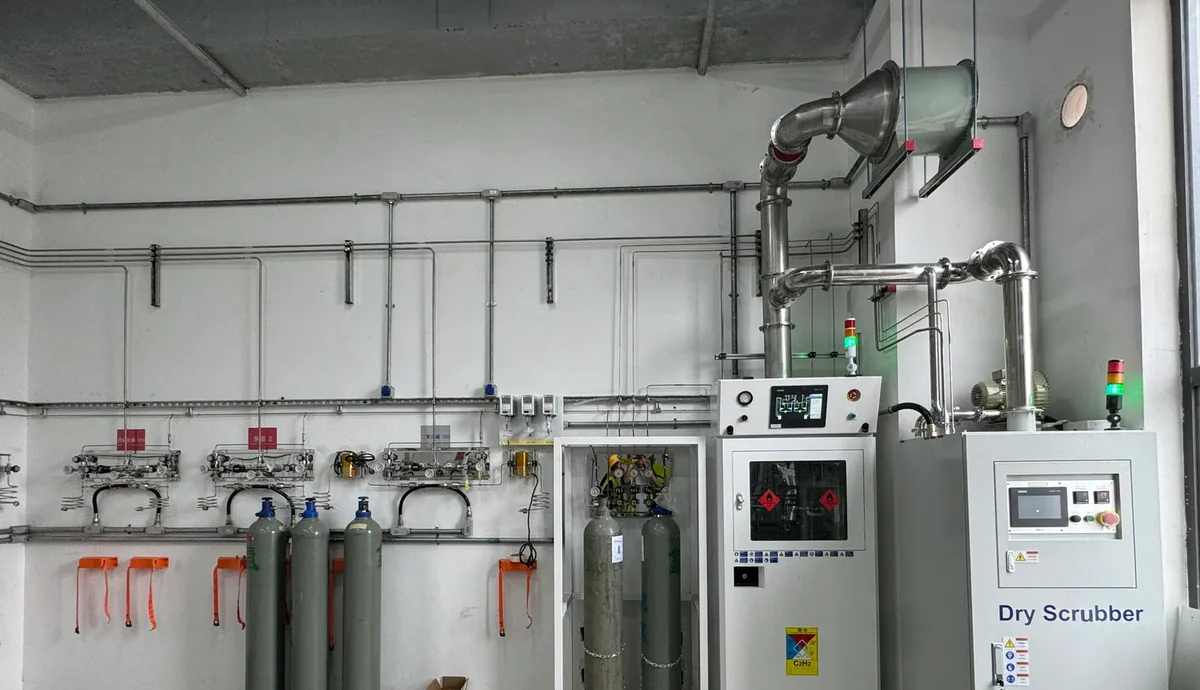
For a GC gas cabinet, exhaust flow is typically a few hundred cubic meters per hour, with higher values for pyrophoric gases such as silane, and abatement can be a dry adsorption or wet scrubber sized for one cylinder. For a BSGS, the abatement unit, the emergency scrubber and the duct size all grow with container size, and the system must also handle the release rate allowed by the container valve and restrictive flow orifice. LGF supplies treatment equipment for both scales, including dry adsorption specialty gas scrubbers and laboratory gas exhaust treatment and purge systems.
Why does a BSGS need more heating than a GC gas cabinet?
A BSGS needs more heating than a GC gas cabinet because heat demand rises with flow rate, and a BSGS delivers far higher flow from one source. Liquefied specialty gases such as ammonia, hydrogen chloride, chlorine and nitrous oxide must absorb heat to vaporize, and compressed gases cool sharply as they expand through a regulator because of the Joule-Thomson effect. At the low flow of a GC gas cabinet, the cylinder wall and the cabinet airflow usually supply enough heat. At BSGS flow rates, ambient heat transfer is not enough.
Insufficient heating in a BSGS causes three common problems: the source pressure falls and flow cannot be maintained, vapor re-condenses in cold piping and creates liquid slugs, and regulators chill enough to freeze moisture or fail. BSGS designs therefore use engineered source heaters or heating jackets, pre-heaters before the first regulator, two-stage regulation close to the source, and heat tracing with insulation on outdoor lines. Heater power on bulk systems is often in the range of one to six kilowatts or more, while many GC gas cabinets need no heater at all.
How do controls and automation differ between the two systems?
GC gas cabinets are available in manual, semi-automatic and fully automatic versions, while a BSGS is almost always fully automatic. A manual GC gas cabinet relies on the operator to open, purge and close valves; a semi-automatic GC gas cabinet automates the purge sequence and shutdown; a fully automatic GC gas cabinet adds automatic cylinder changeover and complete PLC control. The choice for a GC gas cabinet depends on the gas hazard and the operator skill on site.
A BSGS controller has a wider scope. It manages switchover between two bulk sources by pressure and weight, monitors source temperature and heater status, controls automated purge and vent cycles for container connections, logs total flow and consumption, and communicates with the facility monitoring system through Ethernet or a fieldbus. Many BSGS installations use dual PLCs or a hot-standby controller so that one control failure cannot interrupt gas to the header.
How do space, utilities and installation requirements compare?
A GC gas cabinet needs a modest indoor space, typically under one square meter per cabinet plus front access, together with an exhaust connection, control power, clean dry air for pneumatic valves, a purge gas supply, a vent line and connections to the facility gas detection system. Installation is comparable to other laboratory equipment and can be done in an existing gas room or service corridor.
A BSGS needs a dedicated bulk area. The area must allow a forklift, crane or trailer to set the container, must provide containment and weather protection where the source is outdoors, and must satisfy separation distances in local fire codes. Utilities are larger as well: heater power, higher exhaust volume, larger abatement, redundant control power, nitrogen purge at higher flow, and a larger-bore distribution header made of electropolished 316L tubing. Readers planning the header itself can review the laboratory gas piping and fittings procurement guide.
How does purity compare between a GC gas cabinet and a BSGS?
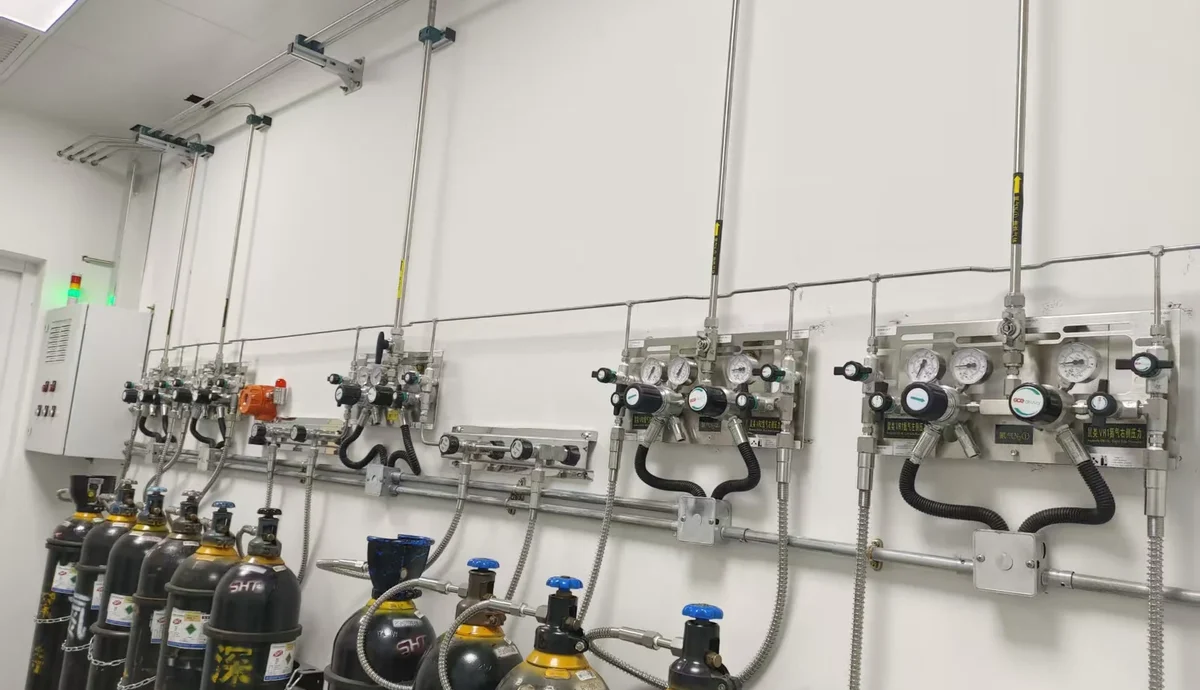
Both a GC gas cabinet and a BSGS can deliver ultra-high-purity gas when the wetted path uses electropolished 316L stainless steel, face-seal fittings, diaphragm valves and helium leak-tested assemblies. The purity difference comes from the gas source and the handling. Bulk containers reduce lot-to-lot variation, because one container replaces many cylinders and one certificate of analysis covers a large volume. Fewer connections and disconnections also mean fewer chances for moisture and air to enter the system during change-out.
The purity risk in a BSGS is concentrated in the long distribution header and in the large container connection. A poorly purged bulk connection or an inadequately heat-traced header can introduce moisture or create condensate that corrodes the system. For this reason, a BSGS specification should include cycle purge with vacuum assist, moisture and particle testing after installation, and inline purifiers or filters where the process requires them.
How do the costs of a GC gas cabinet and a BSGS compare?
A GC gas cabinet has a lower purchase price per unit, but a BSGS often has a lower total cost of ownership when gas consumption is high. Total cost should include equipment, installation, exhaust and abatement, gas purchase price, cylinder or container rental, delivery charges, labor for change-outs, purge gas, downtime and the cost of residual gas returned in each container.
Bulk packaging lowers the cost per kilogram of gas, reduces delivery frequency and cuts change-out labor by up to roughly a factor of ten. A BSGS can also replace several parallel GC gas cabinets, which reduces floor space, exhaust connections and monitoring points. The costs that move in the other direction are the bulk pad or gas yard, larger abatement, heaters and redundancy. A simple comparison is to price the current and forecast gas demand for five to ten years under both options, because the BSGS advantage usually grows as more tools are added.
Which facilities typically use GC gas cabinets?
GC gas cabinets are typically used where hazardous specialty gases are consumed in small or moderate quantities and where each gas serves a limited number of users. Common examples are university and research institute laboratories, analytical and independent testing laboratories, pilot plants, battery and materials research groups, hydrogen fuel cell test benches, and small semiconductor research cleanrooms. In these facilities, flexibility matters more than gas cost, because gases and processes change frequently.
A GC gas cabinet is also the normal choice for low-volume dopant gases and toxic mixtures even inside large fabs, because the consumption of these gases never justifies bulk packaging. LGF project references in this category include semiconductor research specialty gas delivery and university and research laboratory gas supply.
Which facilities typically use BSGS systems?
BSGS systems are typically used in high-volume manufacturing where one specialty gas feeds many tools continuously. Typical industries are semiconductor wafer fabrication, flat panel display, LED and compound semiconductor production, photovoltaic cell manufacturing and optical fiber preform production. Gases commonly delivered by BSGS include silane, ammonia, nitrous oxide, nitrogen trifluoride, hydrogen chloride, chlorine, tungsten hexafluoride and carbon dioxide, depending on the process.
Large research campuses and shared pilot lines also adopt BSGS when one gas is used across many buildings or many tools. LGF examples of bulk-scale specialty gas work include the photovoltaic manufacturing specialty gas system and electronics manufacturing specialty gas distribution projects.
Can a facility combine GC gas cabinets and a BSGS?
Yes, most large facilities combine GC gas cabinets and BSGS systems in a hybrid architecture. High-volume gases are delivered from a BSGS to a header and split through valve manifold boxes, while low-volume, highly toxic or process-specific gases are delivered from GC gas cabinets placed close to the tools. This gives each gas the supply method that matches its consumption and hazard.
Hybrid layouts also improve resilience. A GC gas cabinet can serve as a temporary backup source on a BSGS header during bulk container maintenance, and a facility can start with GC gas cabinets during early ramp-up and convert a gas to BSGS once consumption grows. To keep this conversion simple, the original design should reserve space, exhaust capacity and a header tie-in point for the future BSGS. Downstream distribution hardware such as the JW-200-VMB / JW-100-VMB valve manifold box works with either source.
How should a buyer decide between a GC gas cabinet and a BSGS?
A buyer can decide between a GC gas cabinet and a BSGS by answering six questions in order. Each answer pushes the decision toward one system, and the combined result is usually clear.
- Consumption: How many standard cylinders of this gas would be consumed per month now and in three to five years? High and growing consumption favors a BSGS.
- Number of users: How many tools or instruments use the gas, and are they in one area or spread across a building? Many users across a site favor a BSGS.
- Bulk availability: Is the gas available from local suppliers in Y-cylinders, ton containers or trailers at a reliable delivery schedule? If not, a GC gas cabinet is the only practical option.
- Site space and access: Is there a location for a bulk pad or large gas room with lifting access and code-compliant separation? Without it, a GC gas cabinet is preferred.
- Risk tolerance: Can the facility accept a single source feeding many tools, provided redundancy is installed? Processes that cannot tolerate a shared failure may keep dedicated GC gas cabinets.
- Budget structure: Is the project optimizing initial capital or long-term operating cost? Initial capital favors GC gas cabinets; long-term gas and labor savings favor a BSGS.
What are the most common mistakes when choosing between a GC gas cabinet and a BSGS?
The most common mistake is sizing for today’s consumption only. A facility that installs several GC gas cabinets for one gas and then adds tools often ends up with a crowded gas room, frequent change-outs and no space for a later BSGS. A second mistake is underestimating heating on a BSGS for liquefied gases, which leads to pressure drop and re-condensation in winter or at peak flow.
Other frequent errors include sizing abatement for a standard cylinder when the source is a bulk container, omitting redundancy on a BSGS that serves critical tools, ignoring the forklift or crane access required for container change, and comparing quotations on equipment price alone instead of total cost of ownership. Each of these mistakes is avoidable when the gas schedule, source plan and safety basis are defined before equipment is selected, as described in the guide on how to select laboratory gas delivery systems.
What should an RFQ for a GC gas cabinet or BSGS include?
A request for quotation for a GC gas cabinet or a BSGS should give the supplier enough data to size the source, controls, heating and safety system without assumptions. Include the following items:
- Gas name, purity grade, hazard class and whether the gas is compressed or liquefied
- Source type and size: standard cylinder, Y-cylinder, ton container, bundle or trailer, with valve outlet connection
- Average and peak flow, delivery pressure and number of points of use
- Required control level, switchover method and redundancy level
- Installation location: indoor gas room, outdoor pad, ambient temperature range
- Exhaust availability, abatement requirements and local fire code basis
- Gas detection, fire detection, emergency shutdown and facility monitoring interfaces
- Wetted materials, surface finish, leak rate and cleanliness test requirements
- Utilities available: power, clean dry air, purge nitrogen, vent and vacuum
- Documentation, factory acceptance testing, site commissioning and training scope
LGF provides a structured laboratory gas system product selection guide and technical documents and catalog downloads to help prepare this information.
Frequently asked questions
Does “GC” in GC gas cabinet mean gas chromatography?
No. In specialty gas delivery, “GC” stands for gas cabinet, meaning an exhausted enclosure for one to three standard gas cylinders. It is not related to gas chromatography, although a GC gas cabinet can supply carrier or reactive gases to analytical instruments.
What does BSGS stand for?
BSGS stands for bulk specialty gas supply, or bulk specialty gas system. It describes delivery equipment that supplies a hazardous specialty gas from a bulk container, such as a Y-cylinder, ton container or tube trailer, to a distribution header that serves many tools.
Can a GC gas cabinet be upgraded to a BSGS?
A GC gas cabinet cannot normally be converted into a BSGS, because the bulk system needs larger tubing, higher-flow regulators, heaters, a different source connection and larger abatement. However, a facility can plan a migration path by reserving space and header connections, then add a BSGS and keep the GC gas cabinet as a backup source.
Is a BSGS always installed outdoors?
A BSGS is not always outdoors. Y-cylinder and ton-container BSGS units are often installed in a dedicated indoor gas room with lifting access, while tube trailer and ISO module sources are usually placed on an outdoor pad. The location depends on container size, local fire code separation distances and climate.
Which is safer, a GC gas cabinet or a BSGS?
Neither system is inherently safer; each controls a different level of risk. A BSGS reduces the number of change-outs and connections, which lowers routine handling risk, but it holds a larger inventory, so its worst-case release is larger. Safety depends on correct sizing of exhaust, abatement, detection, redundancy and procedures for the chosen system.
Plan your GC gas cabinet or BSGS project with LGF
LGF Lab Gas Flow designs and manufactures specialty gas cabinets, bulk specialty gas supply skids, valve manifold boxes, high-purity piping and exhaust treatment for laboratories, research institutes and manufacturing plants. Our engineers can review your gas schedule and recommend GC gas cabinets, a BSGS or a hybrid layout. The recommendation covers source sizing, heating, redundancy, abatement and the distribution header. Learn more about our factory strength and manufacturing capacity, core technology and qualifications, and completed project cases.
Ready to compare options for your facility? Send us the gas list, consumption estimates, number of tools and installation location through the LGF contact page. We will reply with a technical proposal, equipment drawings and a quotation tailored to your project. Distributors, EPC contractors and system integrators are welcome to contact us about OEM and project partnership.