
Read time: 12 minutes.
Quick answer: Centralized gas supply is usually worth evaluating when several rooms or instruments consume the same gas, cylinder changes disrupt work, and a properly designed source room and distribution route are available. Cylinder-at-bench supply can be practical for one isolated, low-use, or frequently changing experiment when the gas hazard and local rules permit it. Neither layout is automatically safer, purer, or cheaper. The right choice depends on gas identity, allowable in-room inventory, peak flow, delivery pressure, uptime target, pipe length, maintenance capacity, and total installed cost. Many laboratories need a hybrid.
What is the difference between centralized and cylinder-at-bench supply?
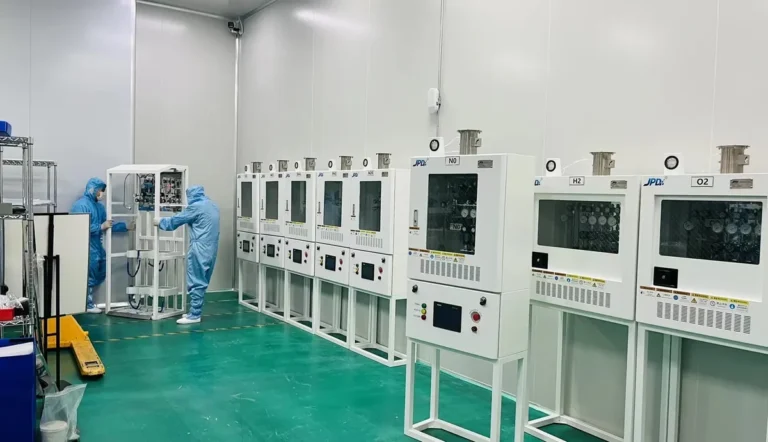
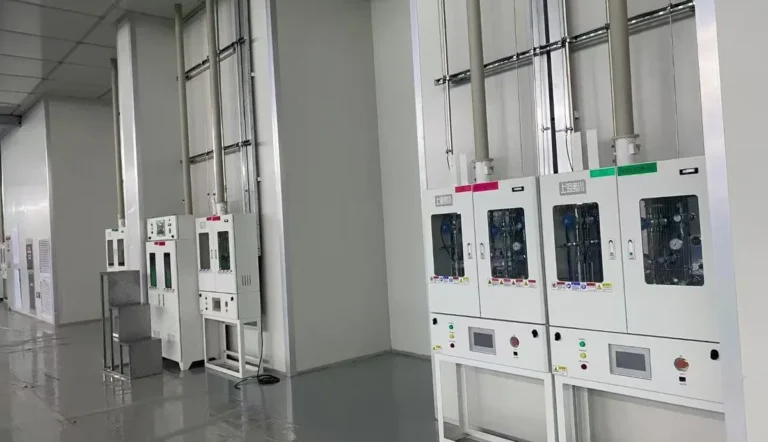
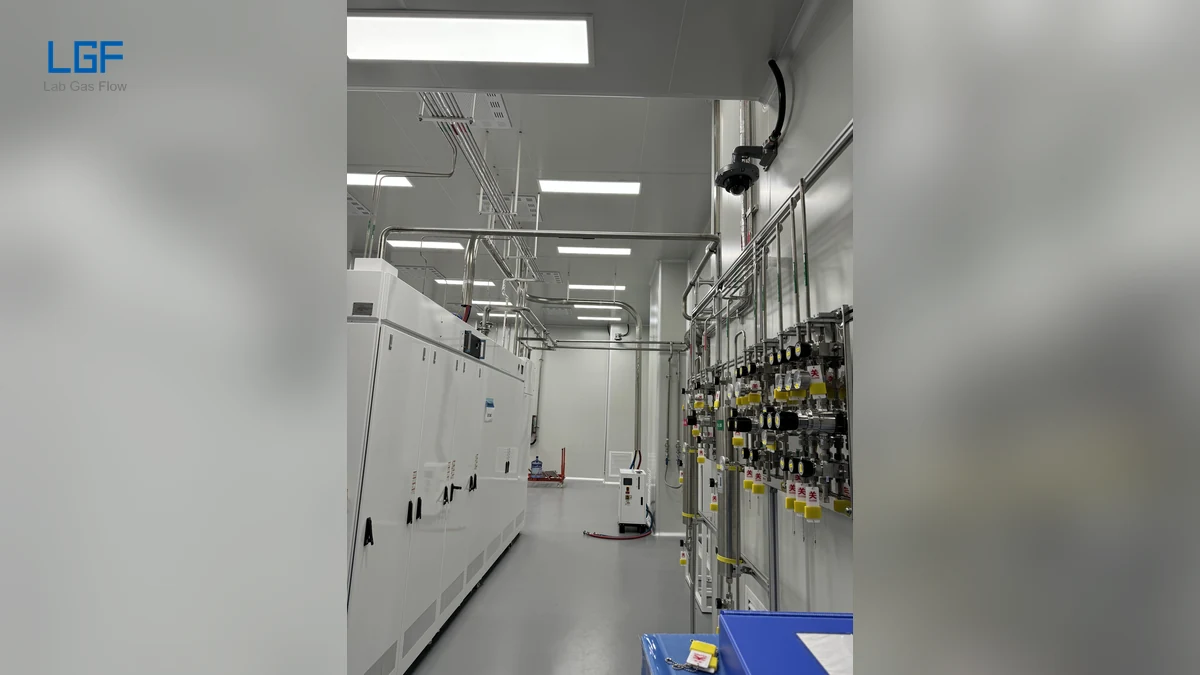
A centralized laboratory gas system stores or generates gas at an approved source location and distributes it through fixed piping to regulated points of use. The source may include cylinders, a manifold, changeover controls, a gas cabinet, a bulk source, or a generator. Isolation, pressure reduction, monitoring, and final outlet controls are selected for the particular gas and application. The laboratory gas delivery systems guide explains those components in more detail.
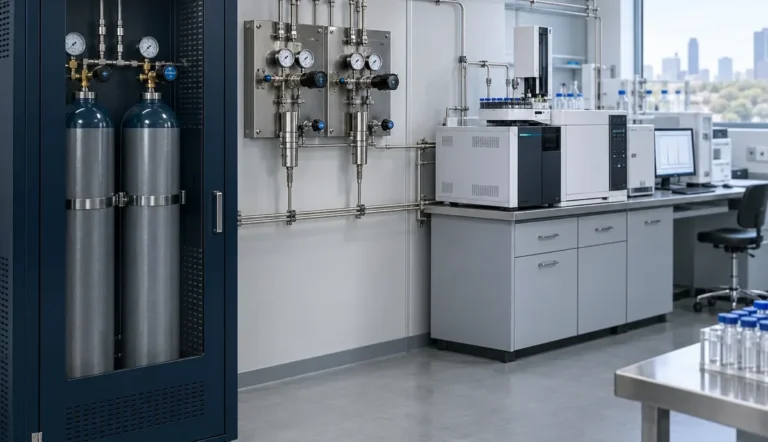
Cylinder-at-bench supply places a cylinder or small cylinder close to the instrument it serves, subject to the laboratory’s approved storage and use rules. The cylinder still needs suitable restraint, a compatible regulator, an approved connection, and a safe route to the instrument. “At the bench” describes the supply location; it does not remove the need for hazard review, ventilation, training, or maintenance.
There is also a middle ground. A laboratory can centralize frequently used inert gases while retaining approved local cylinders for rare specialty mixtures or mobile experiments. A hybrid design avoids building long lines for every gas while reducing routine cylinder handling in busy rooms. The gas list, not a preference for one architecture, should drive the design.
Which option fits your laboratory at a glance?
A useful first comparison asks whether the demand is shared, predictable, and frequent. Repeated demand at many outlets strengthens the case for a fixed network. Sporadic demand at one instrument strengthens the case for a local supply. Hazard classification can override both rules: a toxic, flammable, oxidizing, or asphyxiant gas may require controls that make a simple bench cylinder inappropriate regardless of consumption.
| Decision factor | Centralized supply tends to fit when… | Cylinder-at-bench tends to fit when… |
|---|---|---|
| Number of users | Several outlets need the same gas | One instrument has a separate demand |
| Consumption | Use is frequent or cylinder changeovers are common | Use is low or intermittent |
| Continuity | Changeover and reserve supply protect long runs | Downtime for a local change is acceptable |
| Flexibility | Gas schedule is stable enough to justify fixed lines | Experiments and gas mixtures change often |
| Space | Approved source space and pipe routes are available | An approved in-room cylinder location is available |
| Capital | Multiple outlets can share engineering and source equipment | One isolated point does not justify a long network |
| Maintenance | A team can inspect source, alarms, and piping | A team can manage each local cylinder safely |
This table is a screening tool, not a code determination. A qualified designer and the laboratory’s EHS or facilities team should confirm gas-specific requirements and local approvals before equipment is ordered.
How should gas hazards change the decision?
Gas hazard is the first design gate. A cylinder of inert gas can still displace oxygen; a flammable gas adds ignition concerns; an oxidizer changes fire behavior; and a toxic or corrosive gas can require containment, detection, purge, and exhaust. The controls depend on the specific gas, quantity, building, jurisdiction, and process. A centralized source location can reduce cylinders in work areas, but it also creates distribution piping that must be engineered and inspected.
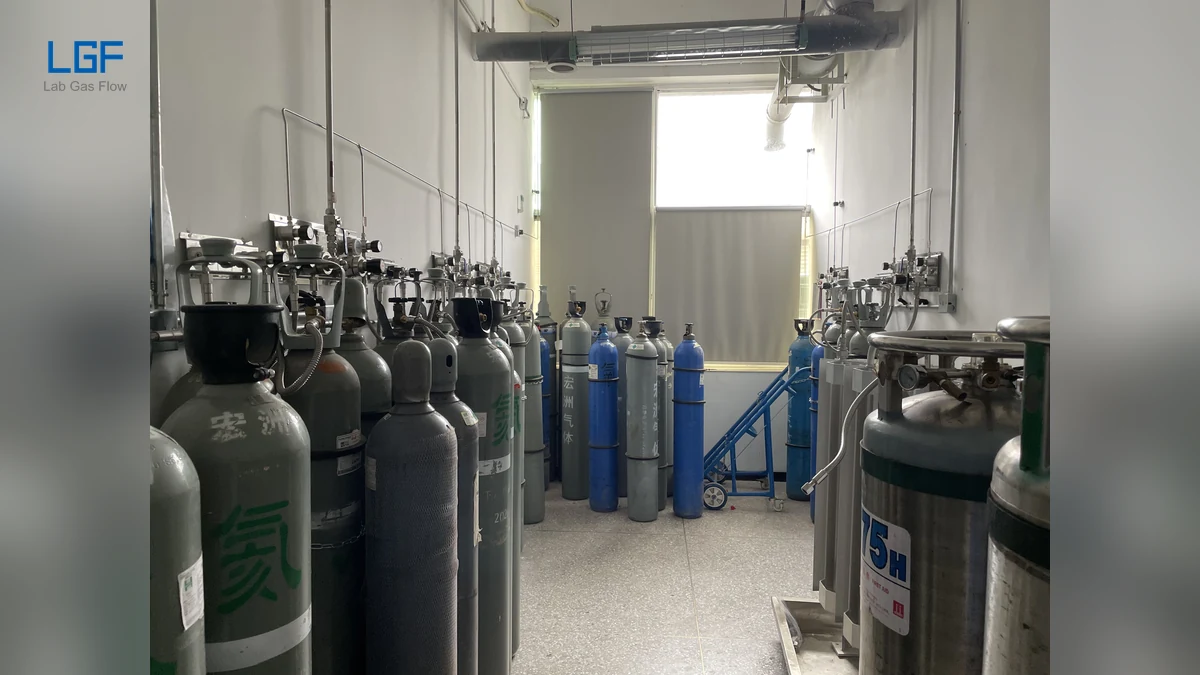
Cylinder-at-bench supply is not a default safety shortcut for a small project. The cylinder must be secured, identified, accessible for approved operation, protected from damage, and connected with compatible parts. Laboratory rules may limit the number or size of cylinders in a room. Keep in-room cylinder counts aligned with the site’s hazard assessment and governing requirements. Never infer that a room is suitable merely because a cylinder physically fits beside a bench.
Centralization can concentrate cylinders and changeover work in an approved source area, which may simplify routine handling in occupied rooms. It can also concentrate the consequences of a source-side failure. A hazard review should examine ventilation, gas detection where required, emergency isolation, alarm response, access control, and safe cylinder exchange. The laboratory specialty gas installation guidelines provide a framework for the engineering discussion, while the project team remains responsible for applicable rules and approvals.
Which layout protects uptime better?
Centralized supply can improve continuity when a properly sized reserve bank and changeover system are included. A source operator can replace an empty cylinder without interrupting every instrument, provided the switching arrangement, alarm strategy, and maintenance procedures work as designed. A simple single-cylinder central source does not offer that benefit. The laboratory gas manifold guide explains the difference between a basic header and a changeover arrangement.
Centralized supply also introduces shared-failure exposure. A closed isolation valve, failed regulator, depleted reserve, damaged line, or maintenance shutdown can affect several rooms at once. Divide critical users into appropriate zones, identify isolation points, and plan what happens during source failure. A laboratory with mission-critical continuous experiments may need redundant supply or a validated local backup rather than one unprotected common header.
Cylinder-at-bench supply isolates many equipment faults by instrument. If one cylinder empties, other instruments may keep running. The tradeoff is frequent local cylinder exchange and variable operator response. A laboratory should compare the real interruption cost: lost sample batches, restart time, calibration work, and staff availability. A purchase decision based only on the price of a manifold misses the cost of a failed overnight run.
Does centralized piping deliver cleaner gas?
Centralized piping can deliver stable gas quality when source selection, wetted materials, cleaning, joining, purging, leak testing, and maintenance are specified for the application. It can also contaminate gas if the line is poorly designed or commissioned. Pipe length, dead legs, trapped volumes, permeable materials, and repeated maintenance openings matter more than the word “centralized” on a drawing.
A local cylinder uses a shorter path to the instrument, which can reduce line volume and simplify a one-off experiment. Yet each cylinder change opens a connection and creates an opportunity for ingress if the change procedure, regulator, and purge arrangement are unsuitable. The correct comparison is delivered quality at the instrument under normal operation and after cylinder exchange, not the certificate attached to the source cylinder alone.
Analytical instruments can be sensitive to moisture, oxygen, hydrocarbons, particles, or other contaminants. Specify the impurity limits that actually matter, the sampling point, and the acceptance method before selecting either architecture. The gas piping and fittings procurement guide addresses material and connection questions that influence delivered quality.
Pressure and flow deserve the same attention. A long central line can suffer pressure drop during simultaneous demand if it is undersized. A local regulator can also be unsuitable for the required flow or delivery pressure. Engineering should calculate the credible simultaneous peak, source pressure range, pressure stages, and allowable pressure variation for every critical instrument.
How do the costs compare over the system life?
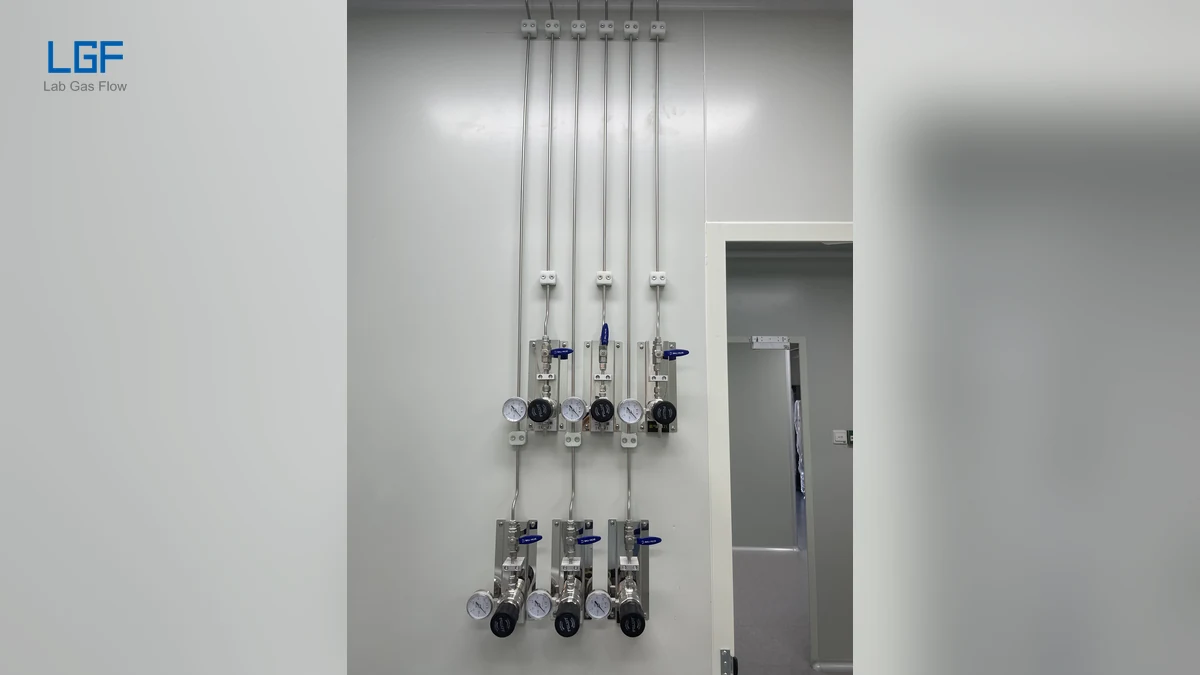
Cylinder-at-bench supply often has a lower initial infrastructure cost for one isolated user. The quote may still need cylinder restraint, compatible regulator, connection hardware, detection or ventilation where required, staff training, and storage arrangements. Repeated cylinder rental, delivery, change labor, gas left in returned cylinders, and production downtime can become significant operating costs.
Centralized supply generally needs more design and installation work: source equipment, pipe routing, supports, valves, outlets, labels, tests, and commissioning. Its cost may be spread across many users, and a shared source can reduce duplicated regulators and room-level cylinder handling. It can also add ongoing inspection, alarm maintenance, and future modification costs. Neither side has a universal break-even point.
Use one five-year or ten-year comparison with the same gas demand assumptions. For each option, add equipment and installation, source rental or purchase, gas delivered, staff time, planned service, expected cylinder changes, test and requalification work, and a realistic cost of interruptions. Include the residual value or future flexibility of installed piping. A “cost per outlet” comparison alone can be misleading when one option serves a single low-use instrument and the other serves an entire department.
A simple break-even model is useful only if its inputs are transparent: incremental central capital cost divided by annual net operating savings equals estimated payback years. The operating savings should be calculated after additional central maintenance and source-room costs, not before. If annual savings are uncertain, show a range rather than a single precise answer.
How do pipe length, gas use, and future changes affect the choice?
Long routes can increase material cost, pressure drop, internal volume, and purge time. They also create more joints and inspection points. A central system is most compelling when multiple outlets share a sensible route and enough recurring demand exists to justify it. Routing one rare specialty mixture across a building may be worse than an approved local cylinder or a short dedicated line.
Future expansion can reverse the decision. A small lab may start with a local cylinder because only one instrument uses the gas. If a second and third room are planned, a reserved source location and accessible pipe route may be worth planning now even if the full network is not installed. Conversely, overbuilding an array of unused lines can create unnecessary cost and maintenance burden.
Labs that change methods often need flexibility at the outlet. Fixed piping works well for stable common gases, while unusual mixtures may remain local. Do not connect a new gas to an existing line solely because the tube diameter and connector appear suitable. Gas compatibility, residual contamination, cleaning, identification, and hazard controls all require review.
When is a hybrid system the strongest option?
A hybrid design often serves the real laboratory better than a forced either-or decision. Centralize high-use, shared gases such as common carrier or process gases when the economics and safety review support it. Keep low-use specialty gases local only where the room and procedure are approved. Separate hazardous or incompatible gases into systems designed for their own controls rather than mixing them into a convenient shared manifold.
A hybrid system can also support resilience. A critical instrument may normally draw from a central line but have a documented backup supply for an approved emergency procedure. That arrangement needs engineered changeover, backflow prevention where applicable, pressure compatibility, and clear operating instructions. A spare cylinder placed near an instrument without a validated connection is not a backup plan.
The hybrid layout should make ownership visible. A drawing should show which party maintains the central source, which team manages local cylinders, who tests outlets, and who responds to alarms. Without that responsibility map, two supply methods can create more confusion rather than less.
What should the design team calculate before selecting equipment?
Begin with a gas schedule. For each gas, list grade, hazard, source format, current and future outlet count, normal and peak flow, normal and minimum delivery pressure, operating hours, and allowable interruption. Mark whether instruments run simultaneously. Add the room locations and realistic routes so line sizing and pressure loss can be calculated rather than guessed.
Next, define the source concept. A cylinder bank needs expected change frequency and reserve capacity; a bulk or generated source needs its own consumption and reliability analysis. Select pressure regulation stages, isolation points, changeover logic, alarms, and outlet hardware for the gas and user tasks. The laboratory gas product selection guide can organize the bill of materials, but project-specific calculations remain necessary.
Finally, document acceptance criteria. Specify drawings, material records, cleaning and packaging expectations, leak and pressure tests, functional tests for alarms and changeover, outlet identification, as-built records, operator training, and maintenance instructions. Qualified professionals should choose test methods and limits appropriate to the gas, materials, and local requirements. An “installed and working” statement is not a substitute for a defined handover package.
How should a laboratory migrate from bench cylinders?
A phased migration starts with an inventory of every cylinder and instrument. Record what gas each device uses, whether the gas is shared, how often cylinders are changed, and which connections or regulators are already approved. This survey often reveals duplicate cylinders serving nearby instruments, but it may also reveal specialty mixtures that should stay local.
Design the new source and network before disconnecting existing cylinders. The migration plan should cover shutdown windows, temporary supply, pressure and purity verification at each new outlet, staff training, and a return or decommissioning process for old hardware. Do not connect instruments to the new line solely because its pressure gauge looks correct; verify gas identity and delivered specification.
One pilot zone can expose operational issues before a whole-building rollout. Measure demand and outlet performance under real simultaneous use, review cylinder changeover behavior, and confirm that users can isolate and report faults. Incorporate lessons into the next zone. LGF’s centralized laboratory gas supply overview provides a starting point for planning source-to-outlet scope.
What should a buyer put in the RFQ?
An RFQ should identify gas identity and grade, hazard review status, source type, outlet schedule, pressure and flow requirements, available source-room conditions, intended pipe routes, required uptime, and future expansion. Ask bidders to return a marked flow diagram, equipment list, materials and connections, line-sizing basis, scope boundary, alarm interfaces, test plan, documentation list, and exclusions.
Compare bids on the same boundary. One supplier may quote manifolds and regulators while another includes piping, installation, and commissioning. A low equipment price is not a low project price if a contractor must still design the route and integrate the safety systems. Ask who owns each interface and who provides local service after handover. A compact single-room lab may also benefit from reviewing a small-lab gas supply approach alongside a full central network.
For B2B procurement, require replaceable part numbers, lead times, spare recommendations, and the documentation language needed by the end user. A distributor or EPC contractor should confirm that equipment can be supported in the destination market. Avoid ordering components by photograph alone; connection standard, materials, seal design, cleaning level, and pressure rating must match the application.
Frequently asked questions
Is centralized laboratory gas supply always safer?
No. A well-designed central source can reduce routine cylinder handling in occupied rooms, but it introduces shared source equipment and fixed distribution lines. Safety depends on gas-specific engineering, installation, monitoring, maintenance, and local approval. A local cylinder can be appropriate when those conditions support it.
Is a cylinder-at-bench system only for small laboratories?
No. A large laboratory may keep an approved local cylinder for a rarely used specialty mixture while common gases come from a central network. Frequency, hazard, instrument location, and permitted inventory are more useful selection factors than building size alone.
Can a central manifold prevent every interruption?
No. A reserve bank and automatic changeover can reduce interruptions caused by an empty source, but they do not eliminate failures in regulators, controls, pipework, or downstream outlets. Critical instruments may require additional isolation or backup planning.
Will a longer central pipeline lower purity?
Length alone does not determine delivered purity. Materials, cleaning, joints, dead volume, leak tightness, purging, and operating practices determine the contamination risk. The acceptance test should be defined at the point where the instrument receives gas.
Discuss your laboratory gas supply layout with LGF
LGF Lab Gas Flow supports laboratories, engineering teams, distributors, and contractors sourcing laboratory gas control equipment and distribution components. Send your gas schedule, room plan, outlet count, pressure and flow targets, hazard requirements, and destination. LGF can discuss whether a centralized, local-cylinder, or hybrid equipment scope fits the project and what information is needed for a useful B2B quotation. Contact LGF to begin the technical review.