
Read time: 10 minutes
Quick Answer: How Do You Choose a Laboratory Gas Valve?
A laboratory gas valve should be chosen in a fixed order: first the gas and its hazard class, then the valve’s job (isolate, meter, block backflow, or shut off automatically), then body and seal materials, pressure rating, leak rate, flow capacity, end connections, and actuation. For most labs, ball valves handle fast isolation, needle valves handle fine flow adjustment, check valves stop backflow, and diaphragm valves serve high-purity, corrosive, or toxic gas lines. Stainless steel 316L is the most widely used body material, but no single material suits every gas.
What Does a Laboratory Gas Valve Do?
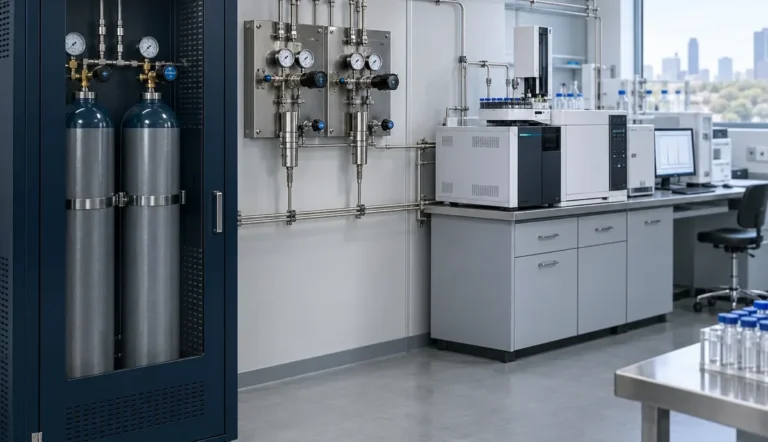
A laboratory gas valve is a flow-control device that starts, stops, meters, or directs gas between a supply source and an instrument or workspace. It protects people by allowing quick isolation of a leaking line, and it protects experiments by keeping gas pure and pressure stable. Because one weak valve can leak, contaminate a gas stream, or fail to close in an emergency, valve selection is a safety and data-quality decision, not only a purchasing task. The laboratory gas delivery systems guide explains how valves fit into the complete source-to-instrument path.
Which Type of Laboratory Gas Valve Should You Choose?
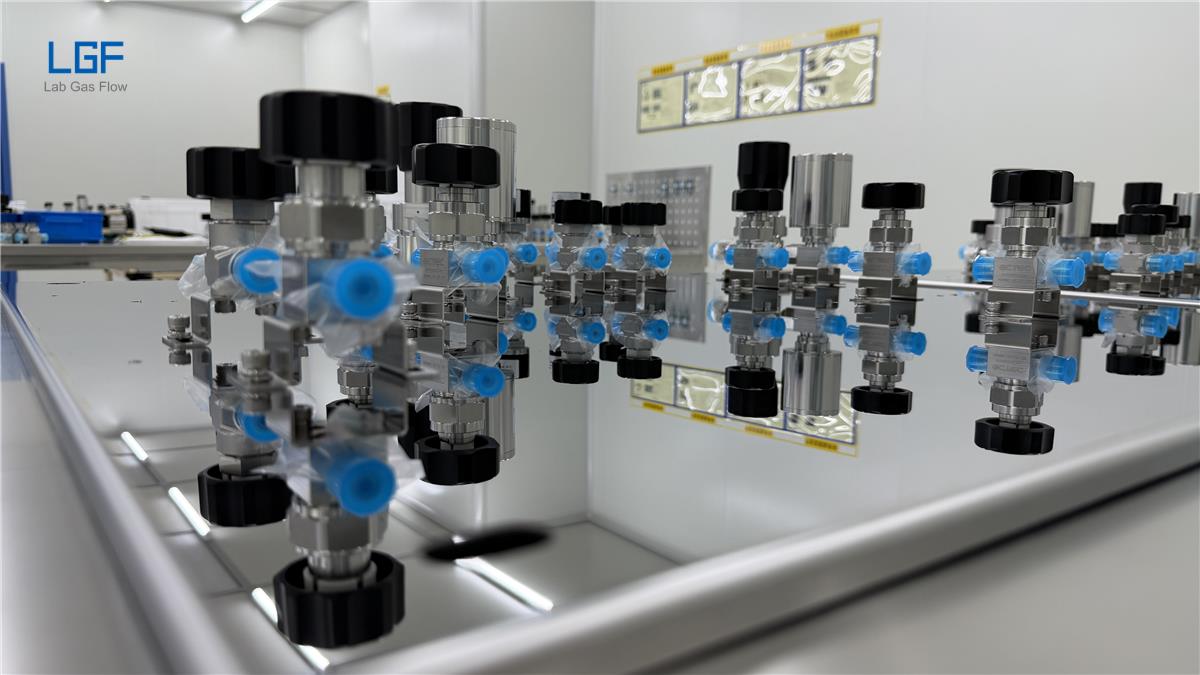
The right valve type depends on the job the valve must do. Each type solves a different problem, and using the wrong one is the most common selection error.
| Valve type | Best used for | Main strength | Main limitation |
|---|---|---|---|
| Ball valve | Fast on/off isolation, utility gas lines | Quarter-turn operation, low flow resistance | No flow metering; trapped volume in the ball cavity |
| Needle valve | Fine flow adjustment at low flow rates | Precise, repeatable metering | Low flow capacity; not ideal as the only safety shutoff |
| Diaphragm valve | High-purity, corrosive, and toxic gases | Gas is isolated from the stem; very low leak rates; minimal dead volume | Higher cost; lower flow capacity |
| Check valve | Preventing reverse gas flow | Works automatically with no operator action | Needs a minimum opening pressure; can leak at very low pressure differences |
| Solenoid or pneumatic valve | Remote and emergency shutoff | Integrates with gas detectors and emergency stops | Requires power or air; must be specified as fail-closed |
In short, a ball valve answers “on or off,” a needle valve answers “how much,” a check valve answers “which direction,” and a diaphragm valve answers “how clean and how safe.” Many gas panels combine two or three types in one line. The laboratory gas product selection guide provides a broader component checklist.
Spec 1: Gas Type and Hazard Class
The gas determines almost every other choice, so it must be fixed first. Inert gases such as nitrogen, argon, and helium are the most forgiving. Flammable gas supply systems using gases such as hydrogen and methane demand a gas-specific review of leak control, ignition sources, and emergency response. Oxygen demands oxygen-clean parts. Corrosive and high-purity specialty gas systems demand compatible wetted materials and a valve construction matched to the specific service.
| Gas group | Typical body material | Typical seal or seat | Key caution |
|---|---|---|---|
| Inert (N₂, Ar, He) | Brass for general use; 316L for high purity | PTFE, PCTFE, FKM | Helium escapes through small leaks, so check leak rate |
| Flammable (H₂, CH₄) | 316L preferred | PTFE, PCTFE | Low external leak rate; avoid high-copper alloys with acetylene |
| Oxygen | Brass or 316L, cleaned for oxygen service | Oxygen-compatible PTFE, PCTFE, or FKM | No hydrocarbon grease; open slowly |
| Corrosive (HCl, Cl₂, NH₃) | 316L or nickel-based alloys | PCTFE, PTFE, metal diaphragm | Moisture speeds corrosion; ammonia attacks copper alloys such as brass |
Treat this table as a starting point only. Always confirm compatibility with the gas supplier’s data and your safety officer before ordering.
Spec 2: Valve Function and Position in the System
A valve’s position in the gas path defines its function, and function defines the valve type. A valve at the cylinder is a primary isolation point. A valve before an instrument is a metering or point-of-use point. A valve on a shared line may need a check valve to stop one gas flowing back into another cylinder. Writing down the function of every valve location before shopping prevents buying a metering valve for an isolation job. A laboratory gas piping design should show those locations before components are ordered.
Spec 3: Body and Wetted Material
Body material controls corrosion resistance, cleanliness, and service life. Stainless steel 316L is the common choice for laboratory gas systems because it resists many gases and cleans well. Brass is economical and works for many non-corrosive gases at moderate purity. Nickel-based alloys are used where aggressive gases would attack stainless steel. Stainless steel is not universally compatible: some halogen-containing gases corrode it quickly when moisture is present, so the actual gas and its moisture level must be checked.
Spec 4: Seat and Seal Material
Seals are usually the first part to fail, so seal material deserves as much attention as the body. PTFE and PCTFE resist most gases and give low particle generation. FKM works well for many general uses but can swell or degrade with certain gases. Metal diaphragms avoid soft seals entirely, which is why they are preferred for ultra-high-purity and aggressive gases. Temperature matters too, because elastomers harden in cold and soften in heat beyond their rated range.
Spec 5: Pressure and Temperature Rating
A valve’s working pressure rating must exceed the highest pressure the valve can ever see, including the set point of any relief device. Full compressed gas cylinders commonly sit at 2,000 psi (about 140 bar) or more, so a valve placed upstream of a regulator needs a high rating. A valve placed downstream of a regulator can have a lower rating, provided a relief device protects it. Check the rated temperature range as well, since both seals and metal strength change with temperature.
Spec 6: Leak Rate and How It Is Tested
Leak rate is the most important measurable quality indicator, and it should always be stated as a number with a test method. General-purpose laboratory valves commonly list helium leak rates in the 10⁻⁷ to 10⁻⁸ atm·cc/sec range, while high-purity metal diaphragm valves often specify 10⁻⁹ atm·cc/sec or better. Phrases such as “leak proof” or “high quality” are not specifications. A proper specification names the leak rate, the test gas, the test pressure, and the acceptance criterion.
Two kinds of leakage exist. External leakage is gas escaping to the atmosphere through the stem or joints, which affects safety. Internal (seat) leakage is gas passing through a closed valve, which affects isolation. Ask which one a quoted number describes, because they are tested separately.
Spec 7: Flow Capacity (Cv) and Orifice Size
Flow capacity is expressed as Cv, the flow coefficient that describes how much fluid passes at a given pressure drop. A valve with too little capacity starves the instrument and causes unstable readings. A valve that is much larger than needed wastes money and gives coarse control. Needle valves usually have low Cv values by design, which is correct for metering but wrong for bulk supply lines. Request the supplier’s flow data at your operating pressure rather than relying on connection size alone.
Spec 8: End Connections
End connections decide whether the valve fits the system without adapters, which are common leak points. Cylinder outlets use standardized CGA connections, and each gas family has its own type so incompatible gases cannot be connected by mistake. Examples include CGA 580 for inert gases, CGA 350 for hydrogen and many flammable gases, and CGA 540 for oxygen. Downstream, panels commonly use compression tube fittings, and ultra-high-purity lines often use metal gasket face-seal fittings. Threaded NPT ends need sealant, and PTFE tape is best avoided in high-purity lines because it can shed particles.
Spec 9: Actuation and Fail-Safe Position
Actuation describes how the valve is operated: by hand, by compressed air, or by an electric solenoid. Manual valves with lockable handles suit routine isolation and maintenance lockout. Pneumatic and solenoid valves allow remote control and automatic shutoff when linked to gas detectors, ventilation alarms, or emergency stop buttons. For flammable, toxic, and corrosive gases, the valve should be normally closed so it shuts when power or air is lost. Always specify the fail-safe position in the order.
Why Oxygen Service Needs Extra Care
Oxygen valves carry a risk that other gas valves do not: rapid opening of a high-pressure line can heat trapped gas enough to ignite contaminants or soft seals. For this reason, oxygen valves should be cleaned for oxygen service, built from oxygen-compatible materials, and opened slowly. Quick quarter-turn ball valves on high-pressure oxygen lines deserve a second look, and many labs prefer slow-opening designs there. Hydrocarbon grease must never touch oxygen-wetted parts.
Which Standards Apply to Laboratory Gas Valves?
Several widely used standards shape valve selection, although local codes always take priority. OSHA rules cover safe handling and storage of compressed gas cylinders in the United States. NFPA 45 addresses fire protection in laboratories that use chemicals, and NFPA 55 covers compressed gases and cryogenic fluids. CGA V-1 defines cylinder valve outlet connections, and CGA V-9 covers compressed gas cylinder valves. Buyers in the European Union should also check the Pressure Equipment Directive (2014/68/EU) for pressure-bearing parts. Ask the supplier which standards each valve was designed and tested to, and request proof.
What Documents Should You Request Before Buying?
Documents turn a price quote into a verifiable purchase. Request material certificates for wetted metal parts, a leak test report with the stated method, a cleaning declaration (especially for oxygen and high-purity service), and lot or serial traceability. For pressure-rated valves, ask for proof of pressure testing. A supplier that cannot provide these should be treated with caution, because the missing paperwork usually means missing quality control.
How Should You Install and Maintain Gas Valves?
Correct installation and routine care keep a good valve performing. The specialty gas installation guidelines describe the wider installation and handover sequence. After installation, test every joint for leaks with an approved leak-detection solution or helium, and purge the line with an inert gas before introducing a reactive gas. Tighten fittings to the manufacturer’s torque guidance. Label each valve with its gas, and use lockout and tagout during maintenance. A common practice is to inspect valves at least once a year, and more often for corrosive gases, then replace seals at the first sign of wear and keep spares of critical shutoff valves in stock.
What Is the Real Cost of a Laboratory Gas Valve?
The purchase price is only a small part of the total cost of ownership. A slightly cheaper valve with a higher leak rate can waste costly gas, shorten the life of downstream equipment, and trigger shutdowns for repairs. In analytical work, a contaminated gas stream can ruin runs and force repeats, which costs far more than the valve. Compare quotes by leak rate, cycle life, documentation, and warranty, not only unit price.
Seven Costly Mistakes When Buying Laboratory Gas Valves
- Using a needle valve as the only safety shutoff. Metering valves are designed for adjustment, so install a dedicated isolation valve.
- Assuming 316L resists every gas. Compatibility depends on the gas, moisture, pressure, and temperature.
- Ignoring dead volume. Trapped gas in a ball cavity can contaminate high-purity lines; diaphragm valves reduce this.
- Mixing fitting standards. Adapters create leak paths and complicate maintenance.
- Using fast-opening valves on high-pressure oxygen. Slow-opening, oxygen-cleaned designs are safer.
- Buying on price without a leak specification. A number and a test method should appear on the quote.
- Forgetting the fail-safe state. Specify normally closed for hazardous gases.
Laboratory Gas Valve Purchase Checklist
Copy this list into your request for quotation:
- Gas name, purity grade, and moisture level
- Valve type and function (isolate, meter, check, automatic shutoff)
- Body material and seat or seal material
- Maximum working pressure and temperature range
- Helium leak rate, test method, and test pressure
- Required Cv or flow rate at operating pressure
- Inlet and outlet connection type and size
- Actuation type and fail-safe position
- Cleaning level (general, high-purity, or oxygen service)
- Standards compliance and required documents
Frequently Asked Questions
What is the difference between a needle valve and a ball valve for lab gas?
A needle valve adjusts gas flow precisely, while a ball valve only opens or closes the line. Choose a needle valve when you need to set a flow rate, and a ball valve when you need quick isolation with low flow resistance.
Is brass or stainless steel better for laboratory gas valves?
Stainless steel 316L is better for high-purity, corrosive, and long-life applications, while brass is a cost-effective choice for non-corrosive gases at moderate purity. The gas and purity requirement should decide, not price alone.
What leak rate should a laboratory gas valve have?
General laboratory valves commonly specify helium leak rates around 10⁻⁷ to 10⁻⁸ atm·cc/sec, and high-purity metal diaphragm valves often reach 10⁻⁹ or better. Hazardous and ultra-high-purity lines should use the lower values.
Do I need a shutoff valve at every gas outlet?
Yes, every gas outlet and every branch should have its own isolation valve so a single section can be shut off without stopping the whole lab. Local codes and your safety officer have the final say on exact placement.
Can one valve be used for different gases?
Dedicating each valve to one gas family is the safer practice. Switching a valve between oxygen and flammable gases, for example, risks contamination and fire hazards.
How often should laboratory gas valves be inspected or replaced?
A yearly inspection is a common baseline, with more frequent checks for corrosive gases or heavy use. Replace a valve when it fails a leak test, shows seat wear, or reaches its rated cycle life.
Final Thoughts
A good laboratory gas valve choice comes from matching the valve to the gas, the job, and the safety requirement, then confirming the match with numbers and documents. Start with the checklist above, compare quotes on leak rate and documentation, and define the required failure response for the gas service. For a project-specific valve schedule or B2B quotation, contact LGF Lab Gas Flow.